
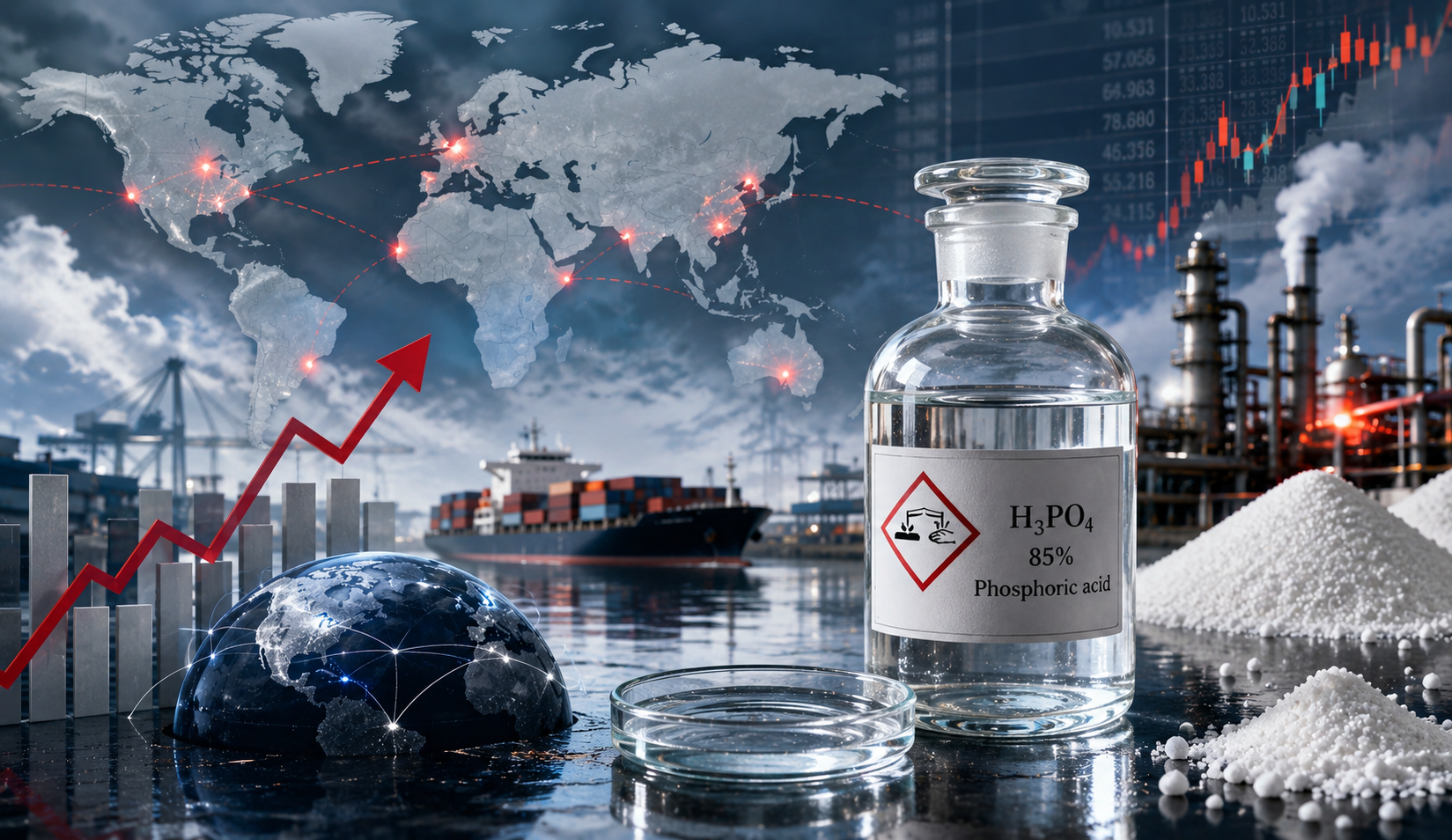
In 2026, phosphoric acid remains one of the key, yet often underestimated raw materials for the food industry and the fertilizer sector. It is used in carbonated soft drinks, meat products, processed cheeses, instant beverages and numerous dry blends. At the same time, it is a basic input for phosphate fertilizers, without which global agriculture can hardly function.
Since 2020, the phosphorus market has been operating under almost constant instability. The pandemic, the war in Ukraine, geopolitical tensions in the Red Sea and the Taiwan Strait, energy shocks, climate extremes and increasingly strict ESG and environmental regulation all feed into the price of phosphoric acid paid by food manufacturers today. Although we cannot rely on hard data beyond mid‑2024, the trends that were clearly visible by then give a solid framework for 2026 as well: high volatility, a “new normal” of higher prices and a need for strategic management of this raw material.
Below, we analyse the main drivers of phosphoric acid prices in the current context, how they affect the food industry and what technologists, procurement and management can do in practice.
Global phosphorus market: concentrated supply and high dependency
The market for phosphate rock and derivatives is highly concentrated. The key players are China, Morocco (and the wider North African region), the USA and, to a lesser extent, Russia and certain Middle Eastern countries. A large share of phosphoric acid goes into fertilizers, while a smaller but technologically very important segment is used in food and pharmaceuticals.
By 2024 it was already clear that two factors are structural rather than temporary. The first is growing global demand for phosphorus to support food production for a rising population, especially in Asia and Africa. The second is that phosphate rock is a finite resource, with increasingly strict regulation of mining and processing. This means that even in 2026 we are operating in an environment where continuous demand growth and constrained supply create price pressure, even in the absence of major crisis events.
For the food industry this has one important implication: when supply becomes tight, the fertilizer sector tends to have priority because of its strategic importance, and the food and technical phosphates segment feels additional pressure on price and availability.
Geopolitical risks and wars: a permanent price factor
The war in Ukraine, which began in 2022, has continued in subsequent years to affect the markets for energy, fertilizers and chemicals. Russia, as an important exporter of phosphate fertilizers and energy, has remained under sanctions, which has diverted trade flows and created new logistical and financial barriers. Every announcement of new restrictions on trade in energy or fertilizers has been reflected in phosphoric acid prices through market expectations.
At the same time, the unstable situation in the Red Sea region and the wider Middle East since 2023 has created a chronic risk for vessels and shipping lanes. By 2026, these risks have not fully normalised, so shipowners still apply a risk premium for transiting these areas, while part of the cargo is rerouted along longer routes around the Cape of Good Hope. This means more days at sea, higher fuel costs and more expensive insurance – all of which feed into the final price of phosphoric acid delivered to Europe and the surrounding region.
Tensions in the Indo‑Pacific, particularly around Taiwan, have further reinforced risk perceptions on chemicals and raw materials markets, given that most global sea trade is linked to Asia. Even without physical disruptions, such tensions are enough for the market to build a “geopolitical margin” into prices.
Logistics and transport: from a one‑off shock to an expensive “new normal”
Disruptions in global logistics after the pandemic initially looked like a short‑term anomaly. However, by 2023–2024 it had become clear that the costs of container and bulk shipping had found a new, higher level. For chemicals and raw materials such as phosphoric acid, this means not only more expensive transport, but also a fundamentally different way of planning.
In 2026, manufacturers and distributors hold larger inventories to cushion potential disruptions. The financial cost of carrying higher stocks, as well as the risk of price changes during storage, is factored into pricing. In addition, congestion at major ports, occasional restrictions on navigation and regulatory pressure on CO2 emissions from shipping all contribute to keeping the freight component of phosphoric acid prices significantly higher than before 2020.
For buyers in Europe and the region, this shows up as a persistent gap between FOB prices at export locations and CIF/DDP prices at their plants. In other words, even when production prices on the global market fall in the short term, the logistics layer and associated risks often absorb much of that decline.
Energy, ESG and the “green transition” of the chemical industry
Phosphoric acid production is both energy‑ and environmentally intensive. In recent years, the prices of natural gas and electricity in Europe have stabilised below crisis peaks, but still above pre‑pandemic levels. At the same time, the EU and other developed economies have introduced stricter CO2 pricing mechanisms as well as special regimes for the chemical industry.
By 2026, many phosphoric acid producers have invested in plant modernisation, wastewater treatment, heavy‑metal control and improved filtration. These investments, although necessary from an ESG standpoint, increase fixed production costs. Combined with energy costs, this results in structurally higher product prices, especially in the EU and other regions with tight environmental standards.
For the food industry, this means that food‑grade and FCC qualities, with strict limits on contaminants, become relatively more expensive compared with technical or fertilizer grades. As international food safety standards become more demanding, there is virtually no room to switch to cheaper, less‑purified alternatives.
Regulatory pressure and the finite nature of phosphorus
Phosphorus is increasingly seen as a critical raw material. The European Union and some member states are implementing policies to reduce phosphorus losses, improve recycling (for example from wastewater and sludge) and better control its use because of water eutrophication.
Although these measures are not aimed directly at phosphoric acid in food, they affect the entire supply chain. Stricter requirements in agriculture, ambitions to reduce the EU’s dependence on imports of critical raw materials from a small number of countries and the promotion of the circular economy all create a regulatory environment in which phosphorus gains strategic importance.
In practice, this can translate into additional administrative requirements, reporting, certification and potentially higher prices for material that meets specified origin and sustainability standards. For companies supplying the EU market, this issue is becoming increasingly important when calculating costs and designing procurement strategies.
Direct impact on the food industry
In the beverage industry, phosphoric acid is essential for the flavour profile and pH of cola‑type soft drinks and some energy and instant drinks. Rising phosphoric acid prices directly affect syrup costs, but also the prices of ready‑made blends and functional ingredients used by smaller manufacturers. In addition to costs, producers face social pressure linked to the perception of phosphates and health, which further complicates formulation decisions.
In the dairy and meat industries, phosphoric acid is mainly seen through the lens of phosphate blends and stabilisers. In processed cheeses, pizza cheeses, spreadable processed cheeses and cheese analogues, phosphates play a key role in fat emulsification, protein dispersion and texture stabilisation. In meat products, phosphate blends influence water binding, juiciness, yield and structure. When the price of base acid and phosphates rises, the increase is passed through to the cost of all these functional ingredients.
In savoury and confectionery applications, the share of phosphoric acid is often smaller, but cumulatively it fits into a broader picture of rising prices for additives, emulsifiers, sugars and cocoa products. For companies with broad portfolios, the cumulative effect of higher costs for multiple “small” ingredients can be significant for profitability.
What food manufacturers can do in 2026: practical steps
Even in an uncertain environment it is possible to significantly reduce risk and stabilise costs if phosphoric acid is treated strategically.
The first step is a solid internal consumption analysis. It is necessary to know precisely where phosphoric acid and phosphate blends are used, in what quantities and how critical those functions are. In some applications, a small dosage reduction or optimisation of the buffering system can deliver savings without compromising quality, while in other categories it may be necessary to maintain existing levels to ensure microbiological safety and stability.
The second step is early and open dialogue with suppliers. Moving away from short‑term, purely price‑driven purchasing to medium‑term arrangements (6–12 months) often brings greater predictability. In some cases, it may be worth considering price indexation to reference market indicators rather than purely discretionary pricing. It is also important to verify whether suppliers have multiple sourcing options and alternative logistics routes.
The third step is developing alternative formulation scenarios. In beverages, this may mean testing part of the portfolio with other acids or combinations of acids, with careful management of sensory properties and brand perception. In meat and dairy, some of the functionality can sometimes be achieved through different processing or by using proteins, fibres or other functional ingredients to improve water binding and texture, thus reducing dependence on phosphate systems in parts of the assortment.
The fourth step is strengthening the S&OP (sales & operations planning) process. Technologists, procurement, finance and sales need to jointly plan phosphoric acid and related additive requirements while monitoring geopolitical and market signals. If it is clear that a new logistics shock or regulatory change is looming, the company should have a plan for early response: whether to temporarily increase inventories, lock in contracts or adjust the product mix.
Balancing price, safety and consumer perception
Beyond the purely economic dimension, decisions on phosphoric acid and phosphates in 2026 are also shaped by consumer trends. Clean‑label demands, media narratives about phosphates and health, and the growing popularity of products with “shorter ingredient lists” are pushing some manufacturers to consider reducing or replacing phosphate additives in certain segments.
In practice, however, many of these additives play an important technological and safety role. Reducing or removing phosphate systems without robust R&D support can lead to problems with microbiological stability, texture, syneresis and shortened shelf life. Ultimately, this can increase waste, complaints and overall costs. It is therefore essential that clean‑label decisions are not driven solely by marketing, but balanced between food safety, cost and consumer expectations.
Conclusion
In 2026, phosphoric acid prices are shaped by a combination of geopolitical tensions, logistical constraints, energy costs, environmental regulation and the structural finiteness of phosphate resources. While it is difficult to predict short‑term fluctuations precisely, the “new normal” of higher and more volatile prices is already firmly in place.
For the food industry, this means phosphoric acid must be treated as a strategic raw material. The companies that will fare better in the coming years are those that understand their true dependence on phosphoric acid and phosphates, work proactively with suppliers, develop alternative formulations where reasonable and integrate raw‑material market data into their business planning.
Instead of asking “what will it cost next month,” the focus shifts to how to build a more resilient supply chain, maintain product quality and safety, and remain competitive in a rapidly changing market.