
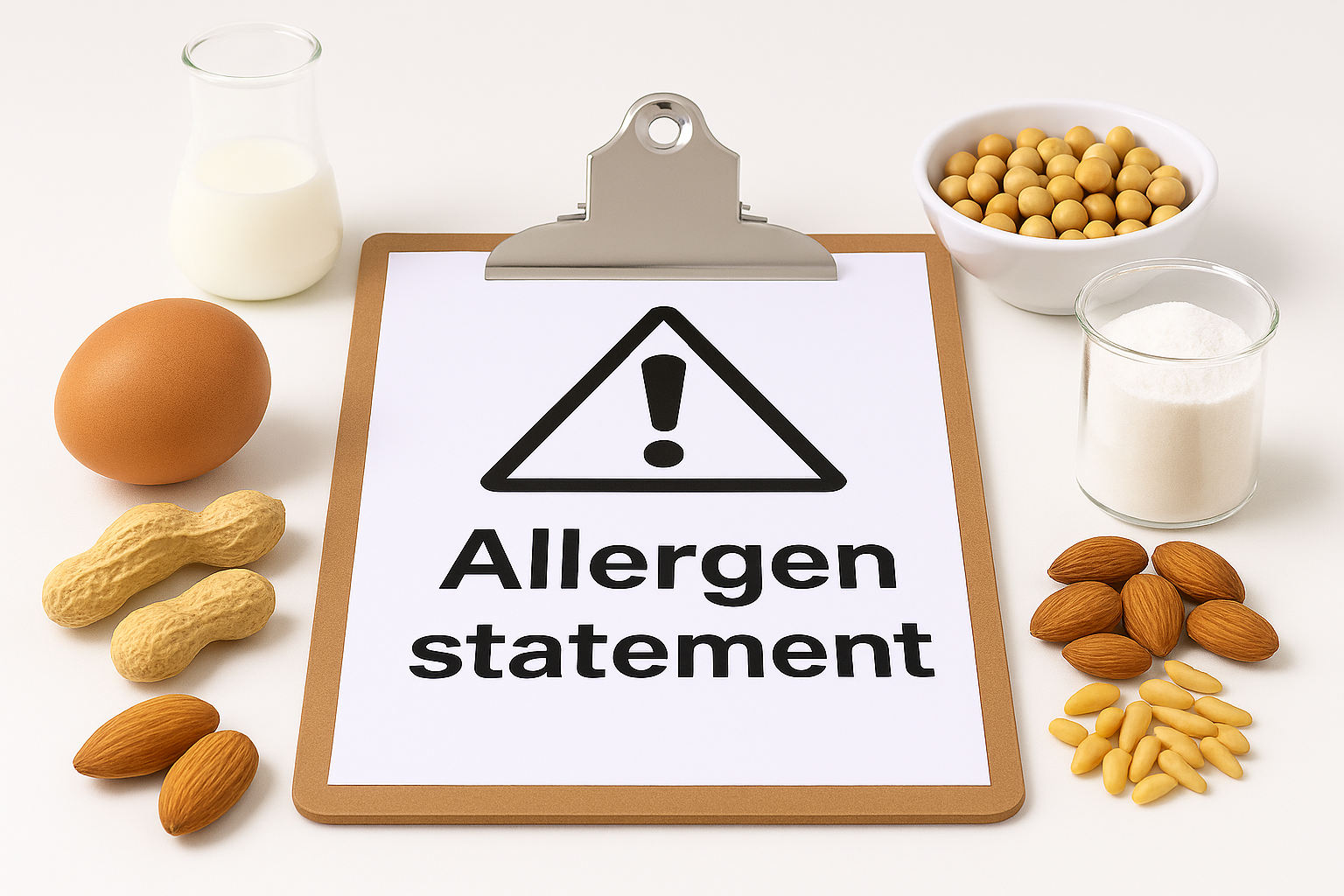
Allergens are one of the most sensitive topics in the food industry. Small mistakes here don’t just mean “regulatory non-compliance” – they can lead to serious health issues for consumers, product recalls and significant damage to brand reputation.
In almost every supplier documentation package today, you will find an “Allergen statement”. However, in practice it often happens that this statement is simply “filed away” without being properly understood or systematically connected to the specification, COA and final product label.
This text explains what an allergen statement is, how to read it, what the typical pitfalls are, and how to use this information in real life in bakery, dairy and confectionery production.
What exactly is an allergen statement?
An allergen statement is a formal declaration by the supplier on the presence or possible presence of allergens in a raw material or ingredient. It is usually based on:
- the composition of the product (declared allergens),
- the raw materials the supplier uses,
- possible cross-contact in the production facility,
- cleaning procedures and separation of production lines.
This statement typically covers allergens defined in legislation (in the EU there is a list of 14 major allergens), with possible additional allergens that the customer or market consider relevant.
The important point: an allergen statement is not a “nice to have” extra document, it is a key element for food safety and correct labelling.
What does a typical allergen statement look like?
Formats vary, but in practice you will most often see two models:
A table with a list of allergens
Allergens are listed in rows (e.g. gluten, milk, egg, nuts, soy, sesame…) and the columns typically indicate:
- “present in product”,
- “may be present due to cross-contact”,
- “not present”.
A textual statement
For example: “Product contains: milk and soy. May contain traces of nuts due to production on shared equipment.”
At first glance this looks straightforward, but problems appear when:
- the document is not up to date,
- terminology is vague (e.g. “traces”, “may contain”, “handled on the same site”),
- customer and supplier have very different interpretations of risk.
That’s why each statement should be read systematically, not just skimmed.
Key questions to ask when reading an allergen statement
Whether you work in bakery, dairy or confectionery, it’s useful to ask yourself the following questions when you receive an allergen statement:
Which allergens are declared as ingredients?
These are allergens intentionally present in the raw material (e.g. milk in milk powder, hazelnut in hazelnut paste).
Which allergens are listed as possible cross-contact (“may contain”, “traces of”)?
These are allergens that are not part of the recipe, but can get into the product due to shared equipment, storage or insufficiently separated lines.
Are the production conditions described?
For example, does the supplier state that nuts, sesame, egg or soy are processed in the same facility?
Is the document dated and version-controlled?
Without a date and version number, you cannot effectively track changes; any serious system requires version management.
Is the allergen statement aligned with the supplier’s specification and label?
If the specification says the raw material is gluten-free, but the allergen statement says “may contain traces of gluten”, you must understand this clearly before including the ingredient in your recipes.
Why is the allergen statement particularly important in bakery?
In bakery, gluten is almost “implicit”, but it doesn’t end there. In practice, bakeries often use:
- milk and dairy products (milk powder, whey),
- eggs (especially in pastries, croissants, sponge cakes),
- nuts and seeds (hazelnut, almond, walnut, sesame),
- soy (lecithins, soy flour).
If your facility produces both standard bakery products and gluten-free lines, any misjudged allergen statement can compromise your “gluten-free” or “free-from” claims.
Example:
You buy a seed mix for topping (sunflower, flax, sesame). The allergen statement says “may contain traces of peanuts and tree nuts”. If you put this mix on a product you market as “free from nuts”, you have a serious issue – even if nuts are not intentionally present.
Dairy: hidden allergen challenges
In dairy, milk is the primary allergen – but that doesn’t make things automatically simple. In every recipe where milk (or milk proteins) are present, you must understand:
- whether additional components (flavours, stabilisers, colours) introduce other allergens (e.g. soy, nuts),
- whether there is a risk of cross-contact from other lines (e.g. facilities that also produce ice creams with nuts or egg-containing products).
Example:
You buy a flavour for a fruit yogurt. The supplier’s label does not show allergens, but the allergen statement says: “Produced in a facility that also processes milk, egg, nuts and soy.” If you use this flavour in products intended for sensitive groups (e.g. children’s food, hospital menus), you must clearly define how you will manage that risk.
Confectionery: a high-risk area for allergens
Confectionery production is naturally “heavy” in allergens, because it regularly uses:
- milk and dairy (milk powder, WPC, caseinates),
- nuts (hazelnut, almond, peanut, pistachio…),
- soy (lecithins),
- gluten (biscuits, wafers as inclusions or layers),
- egg (sponge cakes, fillings, coating masses).
In this sector, the allergen statement for each cocoa product, lecithin, emulsifier, filling, coating or nut paste is practically a mandatory starting point. A single oversight on one ingredient can make the whole line unsuitable for consumers allergic to a certain allergen group.
Example:
You buy a new hazelnut paste for a cream filling. The supplier declares hazelnut as a direct allergen, but in the allergen statement it says “may contain traces of peanuts and other tree nuts”. If you have another product line declared as “peanut free” in the same facility, you must clearly separate flows or revise product claims.
How to connect the allergen statement with the specification and label?
To have real value, the allergen statement cannot remain an isolated document. In practice, it should be integrated with:
Raw material specification
- Intentionally present allergens (ingredients) must be clearly visible in the specification.
- Notes on possible traces must be consistent – if there is a “may contain” in the allergen statement, you must decide internally how to treat this in risk assessment.
Finished product label
- Information from all raw material allergen statements builds the final picture: which allergens you must declare and which you might want to emphasize as absent (“free from X”).
- You cannot claim “free from X allergen” if any raw material in the chain carries a relevant risk of cross-contact with that allergen, unless you have extremely strict and validated controls.
Internal HACCP and allergen management plan
- Based on all allergen statements, you build an allergen map of your facility: where allergens enter, where they are mixed and where they can transfer to other products.
- You then define cleaning procedures, production sequencing, dedicated lines or shifts for gluten-free or free-from products.
Most common mistakes when working with allergen statements
Some typical issues that keep repeating in the industry:
Collecting documents without analysis
The statement is requested “because procedure says so”, but no one systematically reviews it or compares it to the existing labelling and risk management.
Lack of updates
The supplier changes recipe, introduces a new ingredient or moves production, but the old allergen statement stays in your system for years.
Ignoring “may contain” notes
Acting as if “may contain” doesn’t exist, because “nothing has ever happened so far” – until it does happen, usually at the worst possible moment.
Poor communication between departments
Purchasing holds the document, quality archives it, R&D is not informed about allergen changes – and the finished product label stays the same.
How to build a robust system for allergen statements?
Some practical guidelines you can implement:
- For every new raw material: allergen statement is a mandatory part of the initial documentation package, together with specification and, where relevant, COA.
- In supplier approval: QA and R&D must review the allergen statement, not just purchasing.
- In your internal system or database: allergens per raw material are captured as data, not “locked away” in PDFs.
- For every change of raw material or supplier: check if the allergen profile changes and whether your finished product labelling needs to be updated.
- Regular review cycle: e.g. annually, verify that all allergen statements are current (version, date, signature).
Conclusion: allergen statements as a foundation of trust
An allergen statement is not just another piece of paperwork, but a core tool for food safety, regulatory compliance and maintaining consumer trust.
In bakery, dairy and confectionery production, where working with allergens is an everyday reality, good understanding and systematic use of these statements is what separates a stable, controlled system from constant “firefighting”.
The clearer you read, document and connect allergen statements with specifications and product labels, the fewer surprises you will have in production – and the more confident you can be that what’s on the label truly matches what is in the product.