
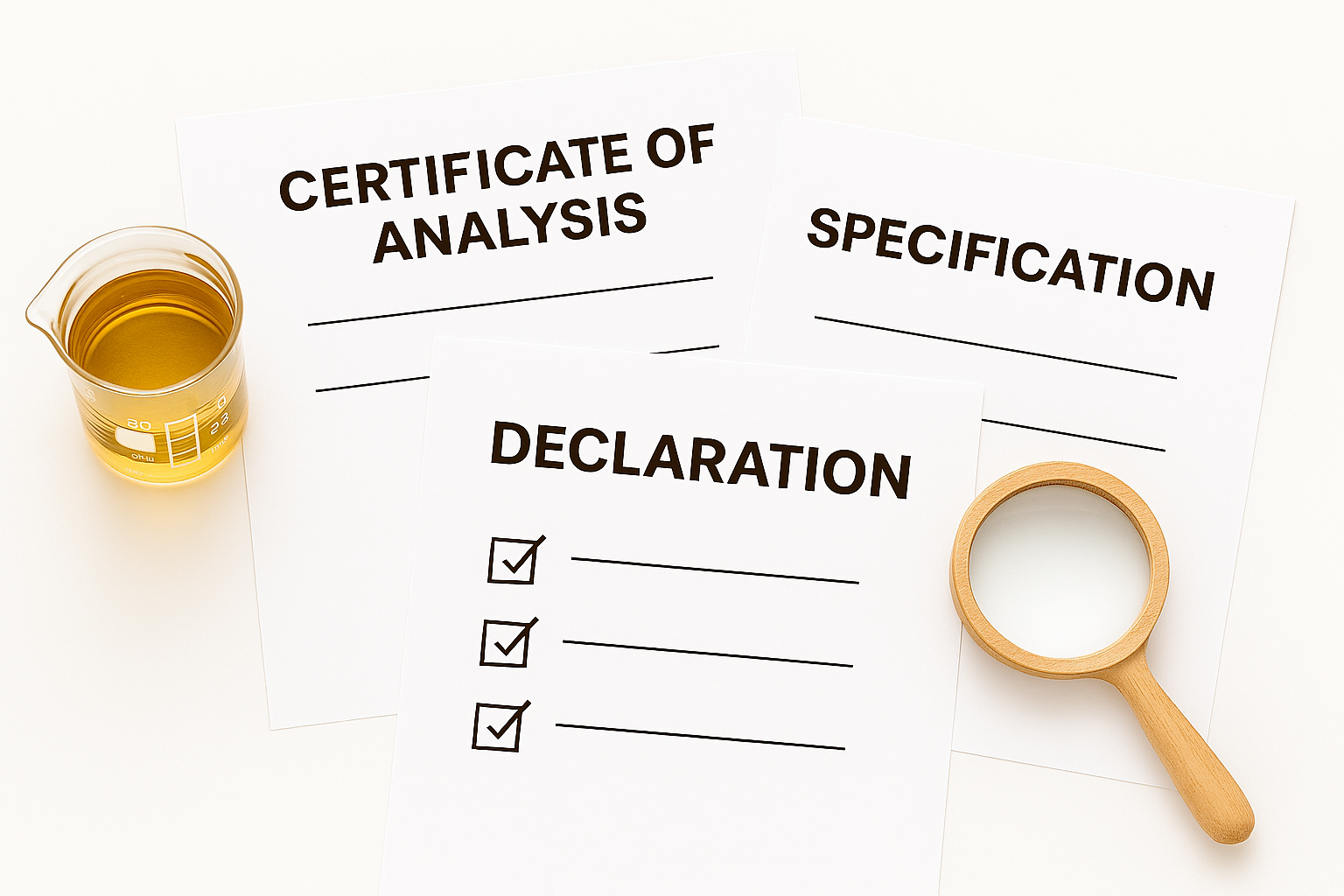
If you work in purchasing, quality or technology in bakery, dairy or confectionery production, you probably see the terms COA, specification and declaration almost every day. Everyone knows they are “some documents” you have to ask suppliers for, but very often it’s not completely clear what each of them is for and what exactly should be checked.
In practice, that’s exactly where problems start: the delivered goods look “OK”, but the COA doesn’t cover critical parameters; the specification is too generic; the finished product declaration doesn’t quite match what you actually receive from your raw materials. The result can be complaints, non-compliance with legislation, or batches of products outside your internal standards.
Let’s break down these terms in a simple way and connect them to everyday situations in food production.
What Is a Product Specification and Why Is It the Starting Point?
A specification is a document that describes what a product is supposed to be. It is the agreed product profile between supplier and customer. Without a specification you don’t really know what you are buying, except for the product name.
For food raw materials, a specification will typically include product name, description, typical intended use in the industry, basic physical and chemical characteristics (moisture, protein, fat, pH, Brix, granulometry, etc.), microbiological criteria, information on allergens, GMO status, shelf life, storage conditions and packaging.
Why is this important in practice? Let’s take two examples.
In bakery production, the same name “wheat flour T-500” from two different suppliers can behave completely differently in dough. Protein content, gluten quality, ash, water absorption can all differ. If you don’t have a clear specification, you rely only on the name and habit. When you change supplier because of price, you may suddenly see lower loaf volume and “strange” dough behavior.
In dairy production, you might buy milk powder or WPC for yogurt or a protein drink. If the specification doesn’t clearly define protein and fat ranges, solubility and microbiology, every new container can behave slightly differently. In the end this shows up in texture, viscosity and stability of the finished product.
That’s why a specification is not a formality; it is the basis for your technologist and QA to say: this product is acceptable for our process, these parameters are critical for us, these variations we can tolerate, and these we cannot.
A good practice is that purchasing should never close a deal with a supplier based only on price and product name. The specification should go through the hands of technology and quality, and they should explicitly approve: yes, we can use this in our application.
What Is a COA (Certificate of Analysis) and How Is It Different from a Specification?
If a specification describes what a product should be in general, a COA refers to what a specific batch actually is. In other words: the specification is the target, the COA is the proof for a particular lot.
The Certificate of Analysis is issued by the supplier for each batch that is delivered. It includes batch number, production date, best-before date, and analytical results of key parameters. These parameters should be aligned with those defined in the specification. For example, if the specification states “protein min. 34%”, the COA will show the actual result for that batch, e.g. 35.2%.
In many companies, the process looks like this: they request a COA, but at incoming goods the paper is just “flipped through” and filed away. No one seriously compares the values with the specification, nor thinks about whether those are really the critical parameters for their application.
In bakery, this might look like the following: for an enzymatic flour improver, the COA lists some parameters that your QA and technologist don’t even check, because they are used to it being “always OK”. Then you get a batch that is within the supplier’s specification, but in combination with your flour it causes too much dough softening or very fast dough maturation. If you haven’t clearly defined in advance which parameters you expect and how you verify them, it’s difficult later to prove that the material “was not suitable”.
In dairy and confectionery the link between COA and daily operations is even more direct. For cocoa powder, milk powder, sugar or fats, variations in moisture, fat or particle size can influence the texture of chocolate, coatings or creams. When something “doesn’t work” in production, the COA is the first document worth pulling out and comparing: is this batch different from previous ones, and in which parameter?
A mature practice is for the company to clearly define for which raw materials a COA is required for every delivery, which parameters from the COA are checked in the internal laboratory, and which are accepted based on the supplier’s data only. In this way the COA becomes a real tool, not just another sheet for the archive.
What Is a Declaration and How Does It Build on Raw Material Specifications?
A declaration is a document intended for the end consumer, i.e. what they see on the finished product label: product name, ingredients list, allergens, best-before date, nutrition table, storage instructions and directions for use.
Although the finished product declaration is formally created by the manufacturer of the finished product, it is directly linked to the specifications and supporting documentation of the raw materials. You cannot correctly declare a chocolate, yogurt or bread if you don’t have reliable data about the ingredients: nutritional values, allergen content, origin of certain components, GMO status, and so on.
In confectionery, for example, cocoa powder, lecithin, milk powder, nuts and other components come with allergens, possible traces of other allergens, and sometimes restrictions regarding pesticides or mycotoxins. All of that needs to be covered in the supplier documentation so that your QA and regulatory team can create a correct declaration.
In dairy, information on fat, protein, sugar and allergens in the raw materials directly feeds into the nutritional information of the finished product. If this part is not accurate, your label will be out of line with reality, which is a very sensitive issue for both inspectors and consumers.
So when you think about the declaration, you’re not only thinking about marketing and packaging design. You are also thinking about whether you receive sufficiently precise and stable data from your suppliers, and whether your internal system is capable of turning that documentation into a reliable finished product declaration.
How Do These Three Documents Work Together?
In the simplest terms, the link looks like this:
First you agree with the supplier on the specification: what you want to buy, which limits you accept, which parameters are critical. This is the starting point.
Then for each delivery you receive a COA, which should show that this particular batch complies with the agreed specification. Here you check whether what physically enters your warehouse really matches what you signed on paper.
Finally, all the information accumulated through specifications and COAs of multiple raw materials is used to formulate and declare your finished product. This is where technology, quality, purchasing and marketing come together: some want the product to work technically, others want it to be safe and legally compliant, and others want a strong market story.
When one of these three elements “breaks”, problems begin. If the specification is poorly defined, you are buying more or less blind. If COAs are only collected formally but not really used, you don’t know exactly what you have in your warehouse. If the declaration is put together just to get the product onto the market, without a solid base in documentation, you risk legal non-compliance, product recalls and damaged customer trust.
Most Common Mistakes and How to Avoid Them
One typical mistake is when purchasing closes a deal solely based on price and product name, without a complete specification. At first everything seems fine, until a batch appears that behaves differently in dough, fermentation or thermal processing. Then people start digging through paperwork retroactively, but it’s too late for proactive control.
Another frequent situation is when the internal specification in a company is stricter than the supplier’s, but this was never clearly communicated. QA and technology have in mind what they expect, the supplier delivers what is written in their standard specification, and both sides think they are right.
A third problem is a superficial approach to COAs: they are requested because “the procedure says so”, but no one seriously works with the data inside or checks whether those are even the right parameters for that particular application.
Regarding the declaration, the mistake is to treat it as “marketing’s job” or “regulatory’s job” without a clear information flow from purchasing and quality. If the team that writes the declaration doesn’t have a clear view of specifications and supplier statements, they are forced to rely on assumptions or on “safest” options, which is often neither optimal nor entirely correct.
What Should You Ask from Suppliers in Practice?
When you introduce a new raw material for bakery, dairy or confectionery production, it’s best to think in terms of building a long-term system rather than buying “just one truck”.
From the supplier you should ask for a clear specification with defined ranges of key parameters, microbiology, allergens, GMO status and storage conditions. For critical raw materials, agree on a regular COA for every batch, with parameters that really matter for your application, not just those that are easiest to measure.
In addition, it is useful to request extra statements when relevant: allergens, GMO, Halal, Kosher, and even pesticide or mycotoxin confirmations for high-risk materials. All of this will later sit in your system and make life easier for QA and regulatory.
Conclusion: Documentation as a Tool, Not a Burden
For an industrial food manufacturer, COA, specification and declaration are not bureaucratic overhead, but tools for risk control. Thanks to them, you know what you are buying, what you are getting, and what you are communicating to the market.
When these three documents are aligned, it is easier to maintain stable quality, avoid costly failures in production, and confidently face inspections or customer audits. Especially in sectors like bakery, dairy and confectionery, where variations in raw materials are very visible in the final product, investing time in good documentation pays back through fewer complaints, less stress, and more stable relationships with customers and suppliers.