
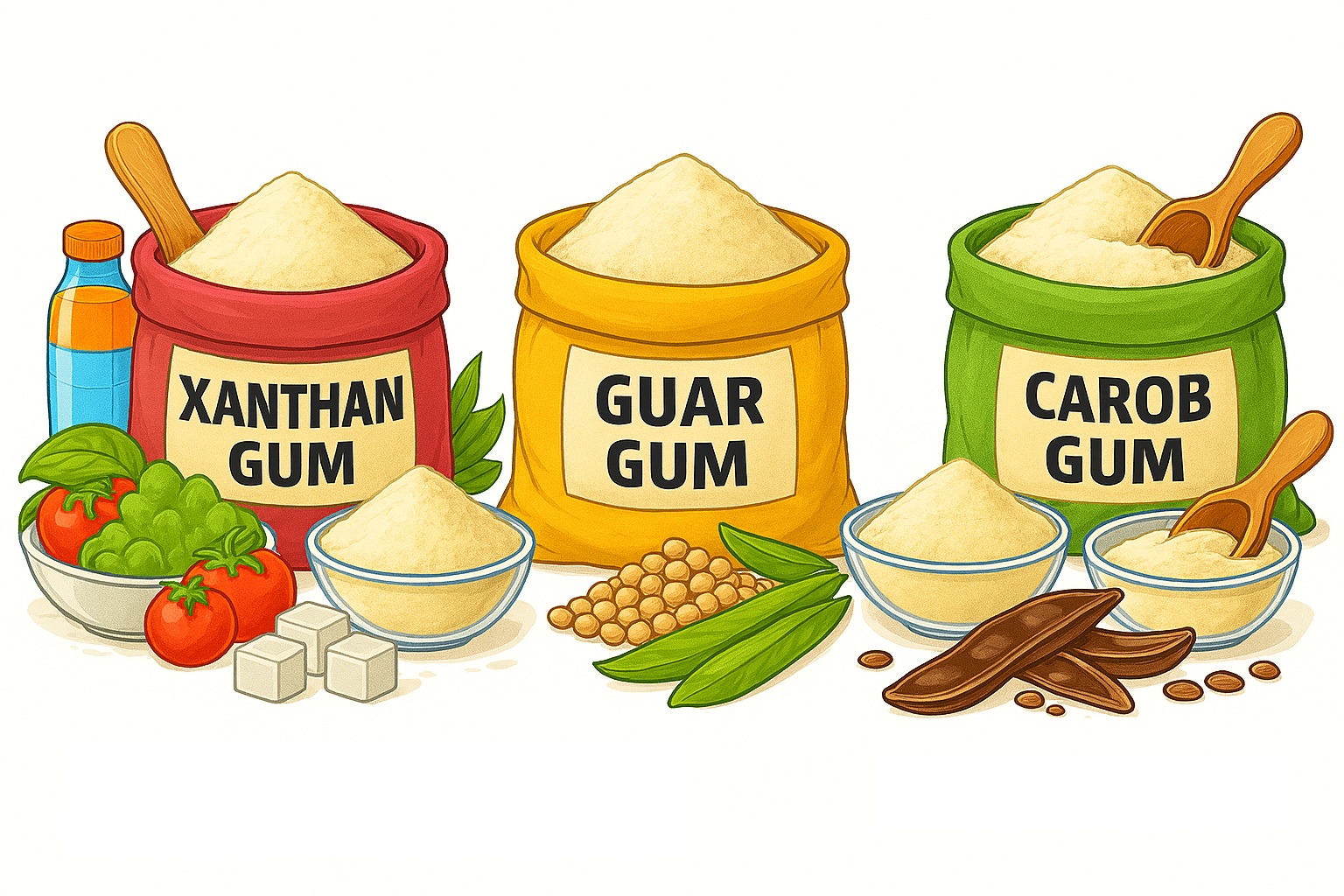
In industrial food and beverage production, choosing the right thickener is not a cosmetic decision. It directly affects texture, stability, shelf life and process efficiency. In practice, technologists and procurement teams very often face the same question: for this product, is xanthan gum, guar gum or locust bean gum the better option?
On paper, all three do the same job – they thicken and stabilise. In real systems, differences in solubility, behaviour under heat and shear, interaction with proteins and sugars, pH tolerance and cost lead to very different outcomes.
Below is a practical comparison designed for R&D, QA and procurement teams who need to align technical performance with commercial reality.
What is xanthan gum and when does it have an advantage?
Xanthan gum is a polysaccharide produced by fermentation (typically using Xanthomonas campestris). It is one of the most widely used thickeners and stabilisers in the food industry. It dissolves in cold and hot water, builds viscosity at low dosages and is very effective in systems with dispersed particles or a risk of phase separation, such as dressings, sauces and beverages with pulp.
Technically, its most important feature is strong pseudoplastic (shear‑thinning) behaviour. At rest the product is thick and stable. Under shear – mixing, pumping, pouring – the viscosity drops and the product flows easily. Once the shear stops, the viscosity recovers.
This is why a salad dressing or sauce with xanthan can be thick on the spoon, yet pour easily from a bottle. For production, this behaviour is useful in filling and pumping, because you can have a high-viscosity product in the package without compromising line efficiency.
Xanthan gum is usually a strong choice in: dressings and sauces that must not separate; beverages and syrups where “body” and mouthfeel matter; suspensions with particles or pulp; gluten‑free doughs that need structure without gluten.
It also tolerates a wide pH range and thermal treatment, which is important for acidified products and those that undergo pasteurisation or sterilisation.
What is guar gum and where does it perform best?
Guar gum is a natural polysaccharide derived from guar seeds. It hydrates in water and builds high viscosity, especially in cold systems. For industrial buyers it is often attractive because of its strong thickening power at comparatively competitive prices.
In terms of texture, guar gum typically creates a soft, full body. It is widely used in dairy drinks and desserts, soups and sauces, bakery products, instant drinks and some types of ice cream. It can help create a perception of richness and creaminess, even when fat or solids are reduced.
Cold‑water solubility and relatively fast viscosity development make guar suitable for processes where there is limited or no heating. On the other hand, if dispersion is not well controlled, guar can form lumps and an uneven texture.
On its own, guar gum may be less stable than xanthan at higher temperatures or in challenging pH conditions. In many formulations it is therefore used in combination with other hydrocolloids, notably locust bean gum, to improve texture and stability while still keeping cost per kilogram of finished product under control.
Locust bean gum: where does it really make a difference?
Locust bean gum (LBG), or carob gum, is obtained from carob seeds. It is commonly grouped with thickeners and stabilisers, but its real strength lies in the way it interacts with other hydrocolloids.
Pure LBG requires elevated temperatures to fully hydrate and show its full effect. Once hydrated, it can form specific gel‑like or creamy structures, especially when combined with other ingredients. Synergy is particularly strong with carrageenan, dairy proteins, pectin and xanthan gum.
This makes locust bean gum highly relevant in products where texture is a core quality driver, for example ice cream with a smooth, stable body and controlled ice crystal growth, dairy desserts and puddings with a creamy, spoonable texture, cream cheeses and spreads that must remain stable over shelf life and through temperature fluctuations, and frozen products where syneresis (weeping) must be minimised.
In these systems, LBG contributes to a fuller body, reduced water separation and better freeze‑thaw stability. It is less about simple thickening and more about designing the exact type of gel‑cream structure the product needs.
How do they differ in texture and mouthfeel?
From a sensory perspective, the three gums behave quite differently.
Xanthan gum usually creates a slick, syrup‑like viscosity with pronounced shear‑thinning. This is ideal for pourable products that must look and feel thick in the mouth but still flow easily from the bottle or through pipes. At excessive dosages, xanthan can bring a slightly “slimy” impression, which is why optimisation of dosage is important.
Guar gum tends to build a round, soft body. In dairy systems and creamy drinks it can mimic some of the fullness associated with higher fat content. If used too aggressively it may produce a heavy or slightly rubbery mouthfeel, but within the right range it can significantly improve perceived creaminess.
Locust bean gum, when used correctly and especially in combination with other gums, tends to create a creamy, cohesive, gel‑like structure. In puddings, ice creams and spreads, it helps achieve textures that hold shape yet feel smooth and rich on the palate, with reduced syneresis over shelf life.
For developers, the key question is not which gum is “stronger”, but what exact texture profile is needed: pourable but stable, spoonable and creamy, sliceable, spreadable – and how that texture behaves under realistic consumption conditions.
Process stability, temperature and pH
In industrial environments, a thickener must survive more than a lab beaker. It will face high shear, heating and cooling cycles, sometimes freezing and thawing, and a wide range of pH conditions.
Xanthan gum is well known for its robustness. It maintains functionality across a broad pH range, including acidic systems, and tolerates thermal processes such as pasteurisation and even sterilisation with limited loss of performance. This makes it particularly useful in acid sauces, dressings, beverages and other products that combine low pH with heat treatment.
Guar gum performs well in cold and moderate temperature conditions. Under high temperatures and in certain pH environments its viscosity can decrease more than xanthan’s. It is still widely used in heat‑treated products, but it requires more careful formulation and process design if long or intense heat treatment is involved.
Locust bean gum typically requires higher temperatures – often around 80–90°C – for full hydration. Once hydrated and properly combined with other hydrocolloids, it can form very stable gels or creamy structures. This is important in applications that involve heating, filling hot and then cooling, and in products that must withstand freeze‑thaw cycles without losing texture.
Cost and dosage: looking at cost per function
Procurement teams usually start from price per kilogram. For hydrocolloids, that approach is incomplete. What really matters is cost per unit of effect – per viscosity level, per texture target, per kilogram of finished product.
Xanthan gum often carries a higher price per kilogram than guar, but it delivers strong viscosity and stabilisation at low dosages. When evaluated on a cost‑per‑function basis, xanthan can be competitive, particularly in liquid and semi‑liquid systems where its shear‑thinning behaviour and process stability are fully utilised.
Guar gum is generally more economical per kilogram and builds substantial viscosity, especially in cold systems. For large‑volume products with moderate texture requirements and strong cost pressure, guar can significantly reduce formulation cost, provided its limitations in heat and pH are respected.
Locust bean gum, especially in synergistic blends, can raise the raw material cost per tonne of product. However, in texture‑driven categories such as ice cream, desserts and premium spreads, the improvement in structure, creaminess and shelf‑life stability may justify the additional cost and support a higher market price or stronger brand positioning.
For rational decision‑making, it is important to compare not only price per kilo, but also required dosage for the target effect, potential savings in other ingredients (for example fat, other stabilisers), process efficiency and the impact on final product value in the market.
A practical decision framework: which thickener when?
Instead of selecting a gum simply because it is cheaper or already on stock, it helps to run through a few focused questions for each application.
What is the target texture: thin but stable dressing, pourable sauce, creamy spoonable dessert, firm cuttable gel, spreadable cheese or dip?
Will the product undergo heat treatment, and at what temperatures and for how long?
What is the pH, and is it stable during process and shelf life?
Is the product exposed to freezing and thawing, for example in ice cream or frozen ready meals?
Does the system contain particles or pulp that must stay suspended without sedimentation?
How sensitive is the business case to raw material cost per kilogram of finished product?
If the main task is to keep a liquid product stable and provide body in an acid and heat‑treated environment, xanthan gum frequently comes out as the primary candidate.
If rapid thickening in cold conditions and a full, creamy mouthfeel at an attractive cost level are the main targets, guar gum often makes commercial and technical sense.
If the core of the value proposition is a specific creamy‑gel texture, resistance to syneresis and robustness through freeze‑thaw cycles, locust bean gum – typically in combination with other hydrocolloids – can be the most effective choice.
In many successful formulations, the best solution is not “either‑or” but a carefully balanced combination. Xanthan can provide stability and shear‑thinning flow. Guar can add body and softness. Locust bean gum can define the final gel‑cream structure and help control syneresis.