
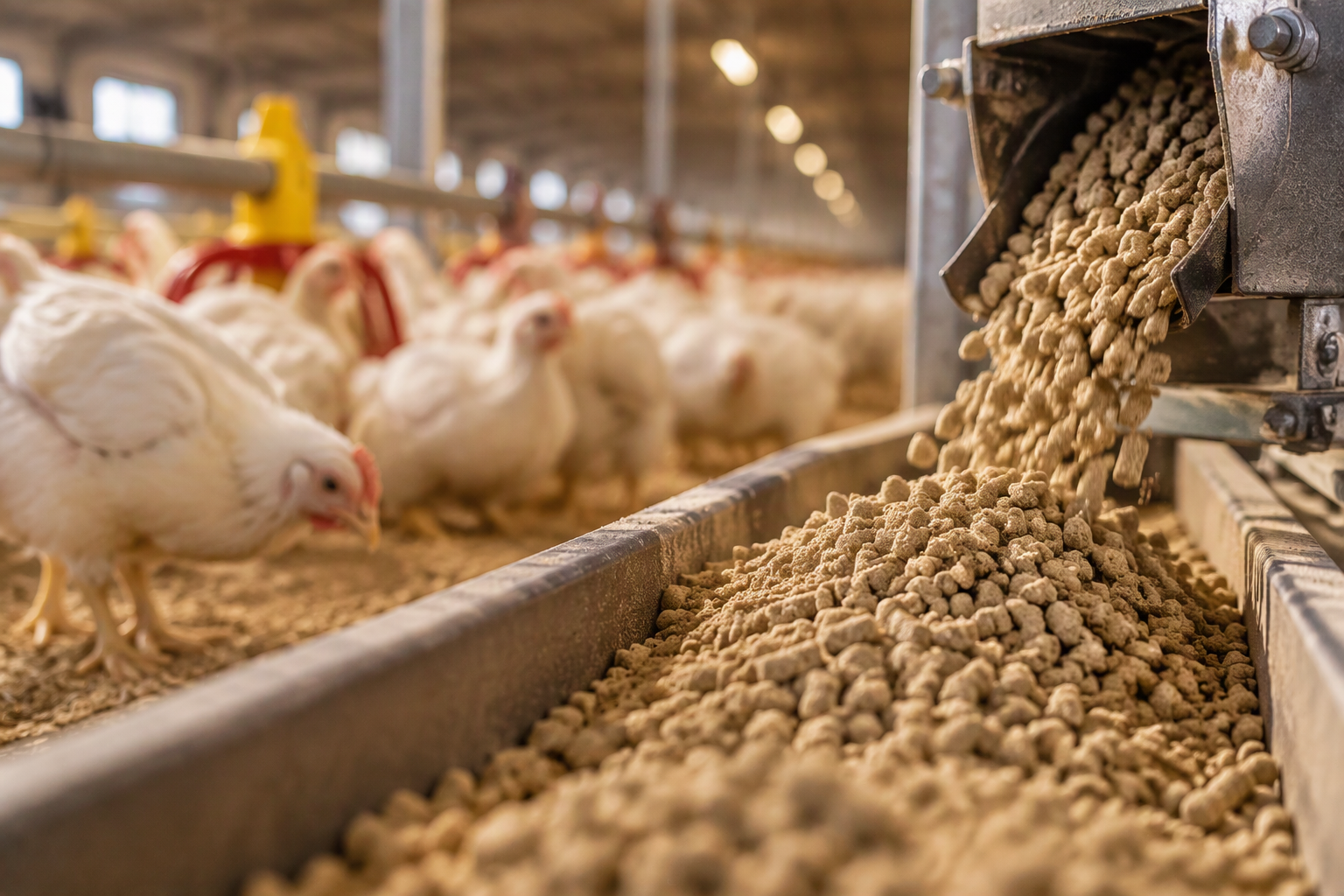
In the world of industrial animal feed production, every gram of nutrients must be maximized. As raw material prices rise and environmental regulations become stricter, nutritionists are looking for solutions that simultaneously reduce costs and increase efficiency. In this context, phytase stands out as one of the most important enzymes in modern formulations.
The Problem with Phytate
Plant based ingredients, such as corn, wheat and soybean meal, contain significant amounts of phosphorus. However, this phosphorus is mainly bound in the form of phytic acid, or phytate. Monogastric animals, such as poultry and pigs, do not have enough of their own enzymes to break this bond. As a result, phosphorus passes through the digestive tract unused, which presents a double problem. On one hand, the animal does not receive the necessary phosphorus, so expensive inorganic phosphates must be added to the feed. On the other hand, the unused phosphorus ends up in manure and reaches watercourses, where it causes serious pollution.
How Phytase Solves This Challenge
Phytase is an enzyme that breaks down phytic acid and releases bound phosphorus. When added to animal feed, it allows the organism to utilize phosphorus from plant based ingredients, thereby reducing or completely eliminating the need to add inorganic mineral supplements.
This change brings multiple benefits. First, recipe costs are significantly reduced, because inorganic phosphates are extremely expensive. Second, phosphorus excretion in manure is reduced, which directly helps in meeting increasingly strict environmental requirements in Europe. Third, phytase does not act only on phosphorus. It also releases other minerals such as zinc, iron and calcium, as well as amino acids that were trapped in the phytate complex.
Technological Challenges and Choosing the Right Enzyme
Although the concept seems simple, the application of phytase in production requires careful planning. The biggest challenge lies in the fact that most animal feed is pelleted. The pelleting process involves high temperatures and pressure, which can destroy the enzyme before it even reaches the animal. That is why thermostable phytases are used in practice, specially designed to survive heat treatment conditions without losing activity.
Also, the efficiency of phytase depends on the pH value in the digestive tract. A good enzyme must be active in the acidic environment of the stomach, but also retain function in later stages of digestion. In addition, it is important to choose between standard dosing and so called superdosing, where phytase is used in larger quantities to ensure the release of even more energy and amino acids.
Why Phytase Is Increasingly Sought After in Europe
European manufacturers face a combination of high raw material prices, the energy crisis and increasingly strict emission regulations. In such conditions, phytase is not just an additive that improves quality, but becomes a tool for survival in the market. It enables the formulation of feed with lower phosphorus content, which reduces dependence on imported mineral raw materials, while simultaneously helping to achieve the sustainability goals demanded by markets and regulators.