
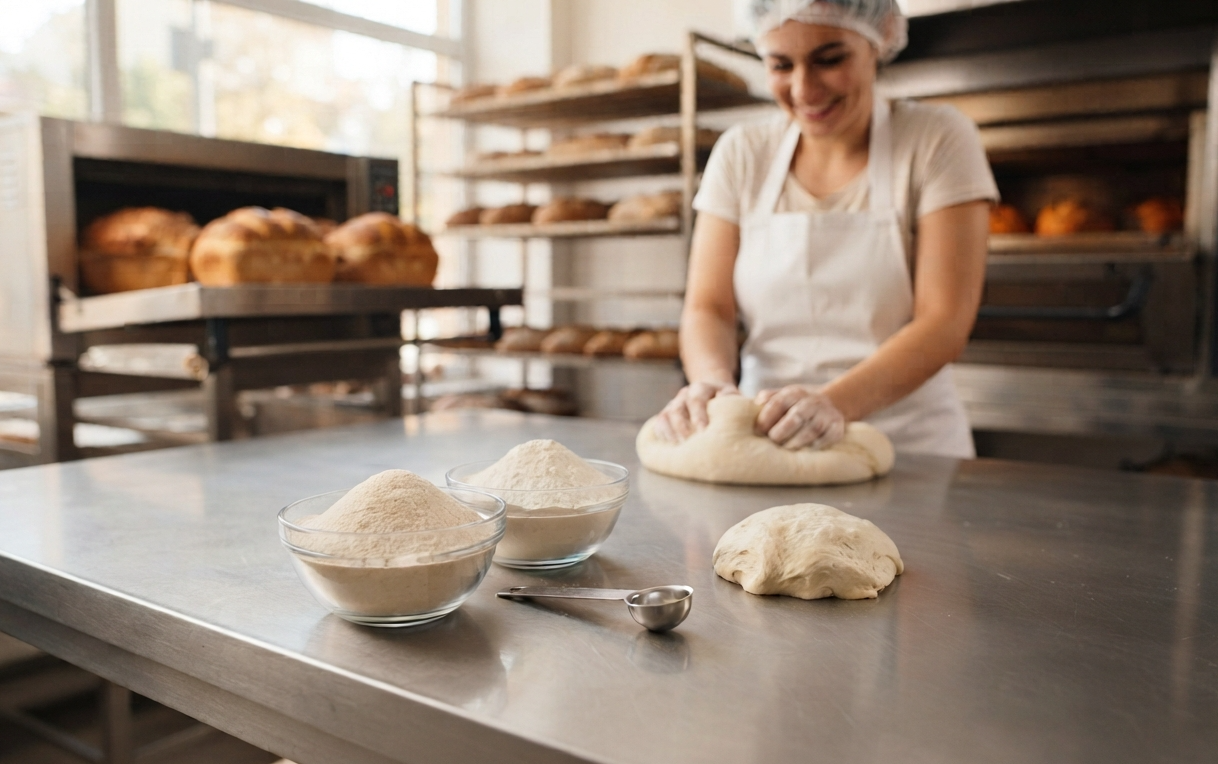
Vital wheat gluten is one of those ingredients found in many bakery products, often without consumers being aware of its presence. For bakers and technologists, it is an indispensable tool that enables consistency, improves texture and extends product freshness. Understanding its role is crucial for anyone involved in the production of bread, pastries or cakes.
What Exactly Is Vital Gluten?
Vital gluten is a protein obtained from wheat flour. It is produced through a wet milling process, in which starch is separated from the flour, leaving a protein concentrate. This concentrate is then carefully dried at low temperatures to preserve its vitality, that is, its ability to re-form an elastic protein network when hydrated.
Commercial vital gluten contains about 73 percent protein in powder form, with minimal fat, moisture and ash content. What sets it apart from ordinary wheat flour is the concentration of proteins and their functionality. Vital gluten consists of two key proteins: gliadin and glutenin. Gliadin provides extensibility, while glutenin provides elasticity. Together, they form a network capable of retaining gases produced during fermentation.
Why Is Vital Gluten Indispensable in Baking?
The role of vital gluten in baking can be viewed through several key functions. First, it improves dough strength. When added to flour with weaker gluten, vital gluten strengthens the protein network, allowing the dough to withstand mixing, shaping and fermentation without tearing or losing shape.
Second, vital gluten increases gas retention. During fermentation, yeast produces carbon dioxide. If the protein network is not strong enough, gas escapes from the dough and the bread does not achieve the desired volume. Vital gluten creates a network that retains these gases, resulting in greater volume and better texture of the final product.
Third, vital gluten improves tolerance to process variations. In industrial bakeries, where production occurs in large quantities, small variations in temperature, mixing time or flour quality can have major consequences. Vital gluten provides a safety margin that allows bakers to maintain consistent quality despite these variations.
Where Is It Applied?
Vital gluten is most used in the production of bread and pastries, especially those with whole grain flour or flour with high fibre content. Fibre from bran interferes with gluten network formation, so adding vital gluten compensates for this deficiency. In these products, vital gluten is added in amounts up to 20 percent relative to flour weight.
In addition to bread, vital gluten is used in pasta production, where it contributes to firmness and elasticity. In plant-based meat alternatives, such as seitan, it is the main ingredient that provides a fibrous texture. It is also used in the production of snacks, crackers and biscuits, where it improves crispness and prevents cracking.
What to Consider in Production?
Although vital gluten is extremely useful, its application requires careful dosing. Adding too much can make the dough too firm and difficult to handle, which can lead to problems in shaping and baking. Also, vital gluten increases water absorption, so the amount of water in the recipe needs to be adjusted. For each percentage of added gluten, water absorption increases by about 1.5 percent.
Another important factor is the drying temperature during vital gluten production. Temperatures above 55 degrees Celsius can denature proteins and destroy their vitality, meaning the product will no longer be able to form an elastic network. Therefore, careful control of the drying process is crucial for the quality of the final product.