
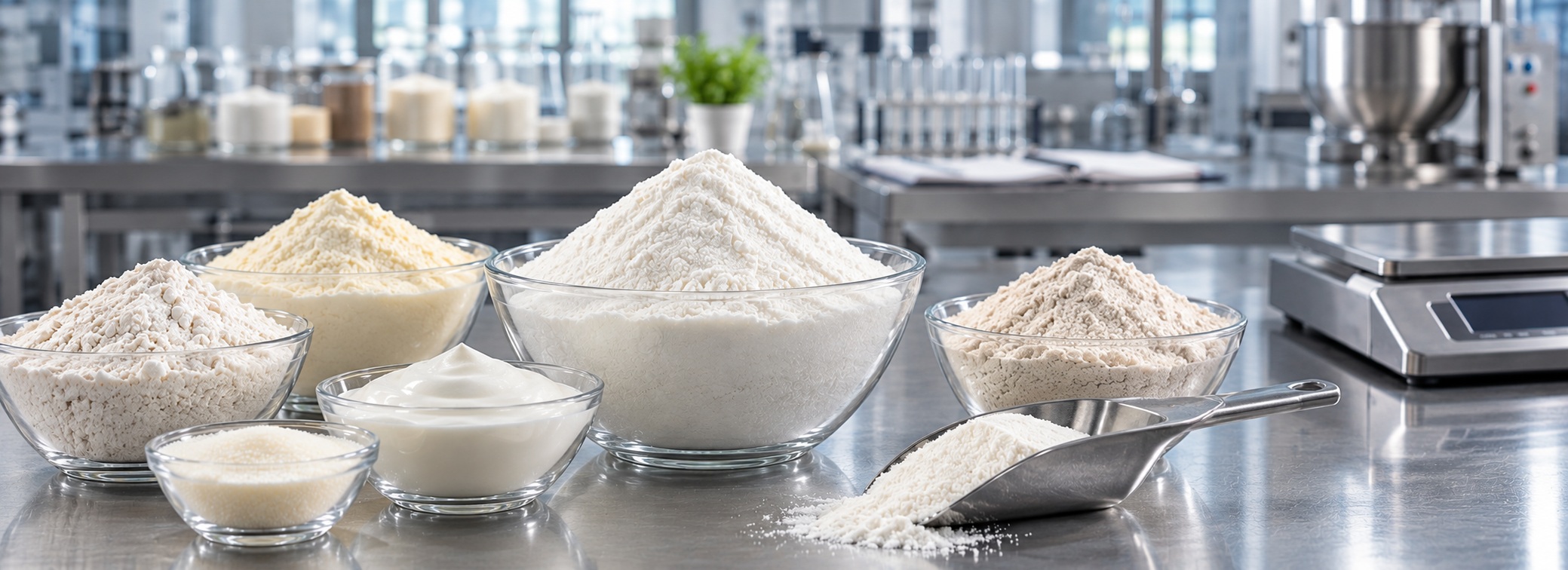
Caseinates are among the most versatile and functional ingredients in the modern food industry. They are derived from casein, the primary protein in cow's milk, which accounts for approximately eighty percent of total milk proteins. While casein itself is poorly soluble in water, neutralization with alkaline solutions produces caseinates, highly functional, soluble milk proteins used across a wide spectrum of food products.
It is precisely because of their solubility and exceptional functional properties that caseinates have become indispensable ingredients in many industrial sectors. In this guide, we will explain the key differences between the three most common types, sodium, calcium and potassium caseinate, and help you choose the right one for your application.
What Are Caseinates and How Are They Produced?
Caseinates are chemical compounds formed by the reaction of casein with alkaline solutions, specifically with metal ions such as sodium, calcium or potassium. They appear as a white to light cream fine powder, representing the soluble form of casein. The production process is relatively straightforward: casein is extracted from skim milk, most commonly through acid coagulation, then washed, dried and neutralized with the appropriate solution. The type of caseinate produced depends exclusively on the alkaline compound used, sodium hydroxide yields sodium caseinate, calcium hydroxide yields calcium caseinate, and potassium hydroxide yields potassium caseinate.
Sodium Caseinate: The Versatile Emulsifier
Sodium caseinate is the most widely used caseinate in the food industry and, according to market analyses, dominates with over fifty percent market share. Its greatest advantage lies in its excellent water solubility, even at high concentrations, with minimal clumping. The solution has a clear, straw-colored appearance with relatively high viscosity.
What makes sodium caseinate particularly valuable are its pronounced emulsifying properties. The molecules contain both hydrophilic and hydrophobic groups, enabling the stabilization of oil-water emulsions. It also exhibits excellent foaming properties, at concentrations of 0.5 to 0.8 percent, it shows greater foaming capacity than whey proteins or egg white powder. Its porous microstructure provides water solubility of approximately ninety percent, with a neutral to slightly milky taste and rapid digestion, making it ideal for pre-workout applications.
In the dairy industry, sodium caseinate is used for protein fortification of milk beverages, drinking yogurts and high-protein yogurts, improving solubility in reconstituted dairy products, as well as stabilizing emulsions and preventing syneresis in processed and analog cheeses. In the confectionery industry, it is applied in cream fillings, coatings and glazes for cakes, biscuits and wafers, caramel and milk fillings, as well as protein and energy-nutrition bars. It is particularly valued in applications requiring rapid dispersion and homogeneous texture without lumps, in protein beverages, confectionery creams, sauces, dry mixes and meat products.
Calcium Caseinate: The Slow Protein for Satiety and Recovery
Calcium caseinate is produced using calcium hydroxide instead of sodium hydroxide and behaves significantly differently from sodium caseinate. In water, it forms intensely white, opaque, milky solutions with relatively low viscosity, in contrast to the clear solutions of sodium caseinate. It has lower water solubility compared to sodium caseinate, only around eighty-four percent, and a compact, dense microstructure. It also has a lower capacity for binding water and fat.
What makes calcium caseinate special is its high calcium content, neutral taste and slow digestion. This provides prolonged release of amino acids, which promotes satiety and supports muscle recovery. An additional advantage is that it reduces sodium content in finished products, while simultaneously contributing to increased calcium content. Although it has weaker functional performance than sodium caseinate, calcium caseinate is extremely versatile and suitable for various formats, from beverages to bars and bakery products. In the bakery industry, a fifteen percent addition of calcium caseinate significantly increases protein content, up to twenty-two percent of total energy value, while improving the textural properties of bread, significantly increasing volume and reducing starch retrogradation. In sports nutrition, slow digestion makes it ideal for overnight muscle recovery and sustained amino acid supply.
Potassium Caseinate: A Specialized Option for Low Sodium Products
Potassium caseinate is produced using potassium hydroxide and shares similar microstructural characteristics with sodium caseinate, porous microstructure, high water solubility of approximately ninety percent and good water and fat binding capacity. Its specialized application lies in dietary formulations with specific nutritional requirements, making it an ideal option for products with reduced sodium content or potassium-enriched products. Thanks to its good emulsifying and stabilizing properties, it is also used in formulations where it is necessary to preserve texture, stability and high protein content without increasing sodium levels. Although its production and market presence are smaller compared to sodium and calcium caseinate, it represents an important raw material in the functional and specialized nutrition segment.
How to Choose the Right Caseinate for Your Application?
The choice of the right caseinate depends on your specific application and desired functional properties.
Choose sodium caseinate if you need excellent solubility and rapid dispersion, if you are making emulsions such as creams, sauces and milk beverages, or if you want high foaming capacity and strong emulsifying and stabilizing properties.
Calcium caseinate is the right choice if you are making sports beverages and protein bars for recovery, if you want to reduce sodium content in your product, if you are making bakery products and want to increase volume and protein content, or if you want to enrich your product with calcium.
Choose potassium caseinate if you are developing low-sodium or potassium-enriched products, if you need dietetically specific formulations, or if you want functionality similar to sodium caseinate without the addition of sodium.
Conclusion
Sodium, calcium and potassium caseinate are three different functional milk proteins, each with its own specific advantages. Sodium caseinate dominates the market due to its excellent solubility and emulsifying properties. Calcium caseinate offers slow digestion and additional calcium, with the possibility of sodium reduction. Potassium caseinate is a specialized option for dietary formulations with reduced sodium content. The right choice depends on your specific application, whether you are developing protein beverages, confectionery creams, sports bars or bakery products.