
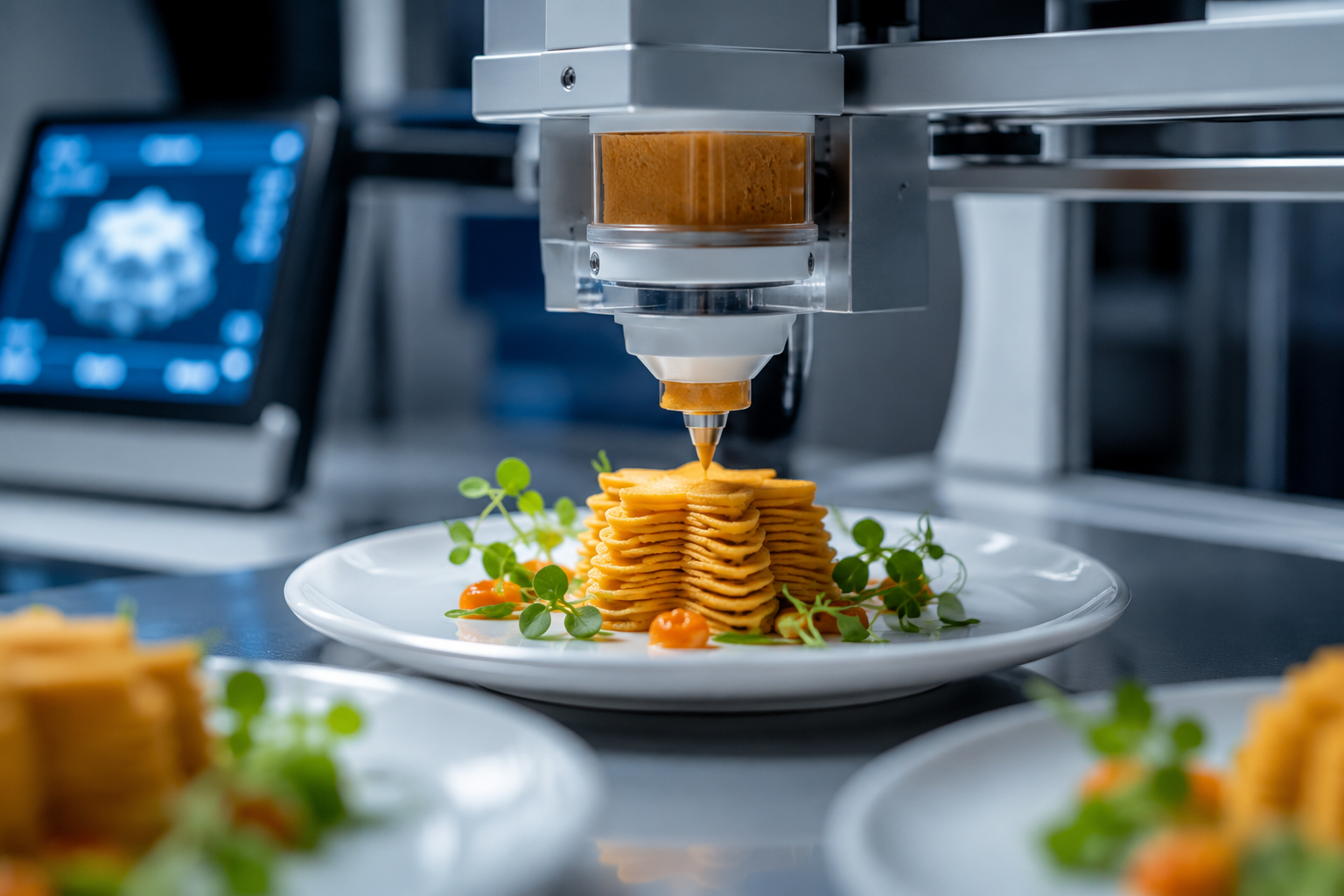
What once seemed like science fiction is gradually becoming reality in the kitchens of top restaurants, research laboratories, and development centers of food companies. 3D food printing brings a completely new approach – from creating complex shapes to personalized nutrition tailored to individual needs.
What is 3D Food Printing?
3D food printing represents the application of additive manufacturing technologies to food products. Instead of traditional shaping, cutting, or molding, edible materials are deposited in thin layers, building a three-dimensional object according to a digital model.
The process unfolds in several steps. It all starts with creating a digital model using 3D software, followed by preparing the "edible ink" – transforming ingredients into a printable form, whether pastes, purees, or powders. The printing itself involves depositing material layer by layer, with each layer typically ranging from 0.5 to 2 millimeters in thickness. Finally, the product undergoes post-processing – baking, steaming, or other methods that give it its final texture and flavor.
What can be printed? Chocolate was among the first materials mastered, thanks to its ideal thermoplastic properties. Today, sweet pastes, sugar, fruit and vegetable purees, doughs based on various flours, fresh cheeses, mousses, and edible gels are also used. Textured plant proteins and even cell cultures for cultivated meat are increasingly appearing.
Where is 3D Food Printing Already Being Applied?
Haute Cuisine and Pastry
Haute cuisine was among the first to recognize the potential of this technology. Michelin-starred chefs use 3D printers to create decorations that are impossible to achieve by hand – geometric chocolate structures, lace-like sugar forms, sculptures that defy the laws of balance.
In pastry, 3D printing enables complete personalization – each cake can be unique, featuring a company logo, portrait, or complex architectural motifs reproduced with millimeter precision. Once a model is created, it can be reproduced identically an unlimited number of times, guaranteeing consistent quality.
Personalized Nutrition and Healthcare
One of the most promising applications is in healthcare. 3D printing enables precise texture control, which is revolutionary for people with dysphagia – a swallowing disorder affecting a significant percentage of the elderly population. Instead of unappealing, pureed meals, patients receive food that looks like a real meal – with recognizable vegetables and structured meat – but with a texture adapted to their swallowing capabilities.
Complete nutrient personalization is also possible – each meal can be formulated with precisely determined amounts of proteins, carbohydrates, fats, vitamins, and minerals, tailored to the individual's health status, age, or physical activity.
Alternative Proteins and Sustainability
Startups worldwide are using 3D printing to create plant-based meat alternatives that faithfully reproduce the texture of muscle fibers. Proteins from peas, soy, lupine, or fungi are combined and structured to resemble different types of meat – from steak to fish.
The technology contributes to waste reduction – using exactly the amount of material needed, eliminating the waste characteristic of traditional shaping and cutting methods. Precise dosing and the ability to use unconventional ingredients open interesting perspectives for valorizing food industry by-products.
Food Industry and Collective Catering
In industrial processes, 3D printing enables standardization and mass customization – a seemingly contradictory concept that means mass production of tailored products. Unlike traditional subtractive techniques that generate waste, additive manufacturing uses only the exact amount of material needed.
In collective catering – school canteens, hospitals, catering services – the same ingredient base can be transformed into different presentations, meeting varied preferences without multiplying stock references.
Transparency is another advantage – each printed food item can be associated with a digital file containing all information about its composition, ingredient origin, and nutritional values.
Advantages and Challenges
3D food printing offers numerous advantages. Personalization allows adaptation to tastes and nutritional needs of each consumer. Creativity comes to the fore through shapes and structures impossible to achieve by hand. Waste reduction is achieved through precise use of required quantities. Nutritional optimization offers exceptional possibilities for public health, while digital traceability guarantees complete transparency about ingredients and origin.
However, significant challenges remain. Equipment cost represents a substantial investment, and the price per kilogram of printed food remains significantly higher than conventional products. Printing speed is slower than traditional production – creating a complex object can take several tens of minutes or even hours. Ingredient limitations are significant – not all foods are printable, as viscosity, elasticity, and shape retention impose specific formulations. Finally, consumer acceptance presents a challenge, as some of the public still associates this technology with "artificial" food.
Market and Future Outlook
The 3D food printing market is estimated at $1.35 billion in 2026**, with projections of growth to **$2.92 billion by 2030. Some reports predict even more ambitious growth – up to $10.09 billion by 2034, with an average annual growth rate of 38.1 percent.
The most mature segments are haute cuisine and pastry, where investment is quickly amortized through high added value. Healthcare applications are growing rapidly, especially in developed countries with aging populations. The food industry is still exploring possibilities through pilot projects.
Regionally, Europe leads in academic research – particularly the Netherlands and Spain. The US is a leader in commercial applications and food tech innovation, while Japan and South Korea are furthest ahead in integration into hospitality and healthcare.
What Does the Future Hold?
The technology does not stop evolving. 4D printing is already being discussed – where the shape, flavor, or color of products changes over time under the influence of temperature or humidity. Imagine pasta that takes on its desired shape after cooking or a beverage that changes color to signal temperature change.
Artificial intelligence is being integrated into the process – optimizing formulations, adjusting printing parameters, and enabling food to meet specific dietary needs and taste preferences.
Regulatory frameworks are still developing – health authorities are working on standards for hygiene, ingredient certification, and product labeling.
Space exploration sees 3D printing as key to producing varied and nutritious food from limited resources during long missions.
Conclusion
3D food printing is at a turning point today – after a phase of experimentation, it is entering a phase of maturation and commercial deployment. Although challenges such as cost, speed, and consumer acceptance remain, the opportunities it offers – personalization, creativity, nutritional precision, and sustainability – make it one of the most exciting innovations for the future of the food industry.
From the kitchens of top restaurants to factories and hospitals, 3D food printing is shaping the contours of a more flexible, sustainable, and individualized food system. The question is not whether this technology will enter the mainstream, but when – and who will be the first to leverage its advantages.