
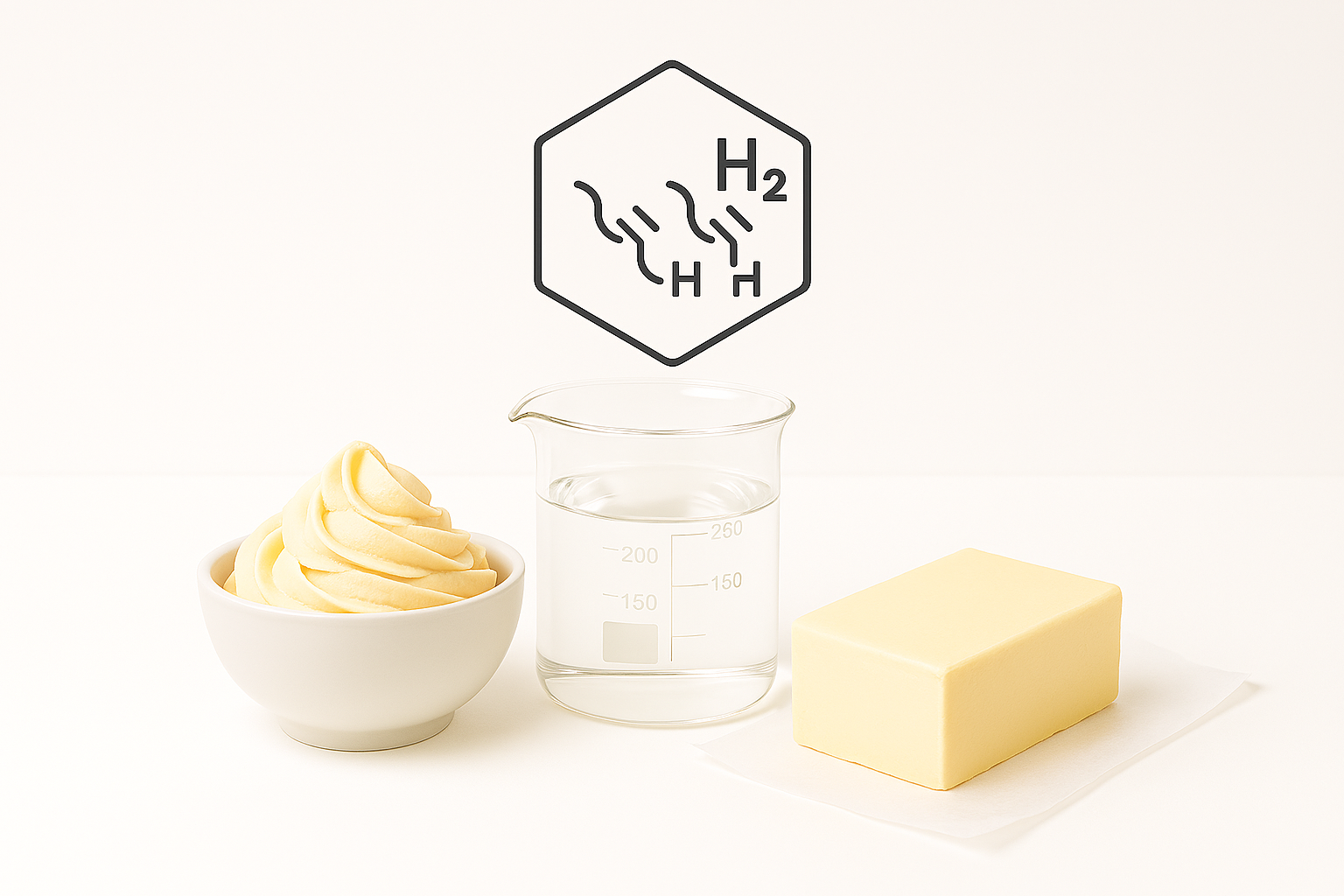
Fats are one of the key functional ingredients in the food industry. They do not only contribute to flavour, but also to texture, spreadability, foam and emulsion stability, as well as shelf life. For decades, fat hydrogenation was a standard technology for tailoring the physico‑chemical properties of oils and fats to industrial needs. With the increased awareness of trans fatty acids and stricter regulatory limits, the way hydrogenation is applied has changed dramatically.
This article focuses on the technological side: what actually happens during hydrogenation, how it affects texture, stability and shelf life in different product categories, and what the practical implications are for today’s food technologists.
What is fat hydrogenation? – technological basics
Hydrogenation is a process in which hydrogen atoms are added to double bonds of unsaturated fatty acids in the presence of a catalyst, typically nickel, at elevated temperature and pressure. The starting materials are liquid vegetable oils rich in unsaturated fatty acids. The goal is to saturate part of these double bonds, thereby increasing the melting point and changing the crystalline structure of triglycerides.
In full (total) hydrogenation most of the double bonds are converted to single bonds, and the oil becomes practically a saturated fat with a high melting point, with minimal formation of trans isomers. In partial hydrogenation, a significant share of cis double bonds is isomerised to the trans configuration, leading to the formation of trans fatty acids, which are nutritionally undesirable. Between these two extremes lies a spectrum of possible fat profiles, depending on process intensity and the targeted functionality.
For technologists it is important to understand that hydrogenation is not just “hardening” an oil, but a fine‑tuning of triglyceride distribution, crystal forms and melting profile, which directly determines performance in a given formulation.
Impact of hydrogenation on product texture
Product texture largely depends on the physical state of fat at ambient and processing temperatures. In non‑hydrogenated oils, fat is mostly liquid, which is limiting in applications where a firm, creamy or laminated structure is required. Through hydrogenation, the solid fat content at particular temperatures is increased, and the textural profile is modified.
In bakery applications, hydrogenated fats provide good plasticity, the ability to create and maintain layers in puff pastry and structural stability after baking. The network of solid fat crystals separates dough layers and contributes to flakiness. Insufficiently hard fat leads to layer collapse, reduced volume and poor development of the laminated structure.
In confectionery, margarines and speciality vegetable fats for creams, fillings and icings must have a defined temperature range in which they are soft enough to process yet firm enough to hold shape. Hydrogenation helps to design such a functional window. The melting profile governs mouthfeel, creaminess and the absence of waxy or grainy sensation.
In spreads, stable, finely crystallised hydrogenated fat provides smoothness, easy spreadability and prevents oiling‑out on the surface during storage. Excessive hardness or an inappropriate crystal form results in a “sandy” feel and poor spreadability, whereas insufficient hardness leads to oil leakage and shape instability.
In meat products, harder vegetable or blended fats created through hydrogenation contribute to sliceability, shape stability of sausages and pâtés, and overall product firmness. Fine dispersion of fat crystals influences juiciness and the perception of fattiness during chewing.
Fat stability: oxidation and rancidity
One of the key benefits of hydrogenation is increased oxidative stability. Unsaturated fatty acids, especially polyunsaturated ones, are highly prone to oxidation, which leads to rancid off‑flavours, colour changes and loss of nutritional quality. By saturating double bonds, the fat becomes chemically more stable.
After hydrogenation, the proportion of polyunsaturated fatty acids is reduced, while saturated and monounsaturated fractions increase. This slows down oxidation and extends the period before noticeable off‑flavours appear. In practice this means longer shelf life without significant deterioration of organoleptic properties, especially in products exposed to air, light and elevated temperatures during storage or distribution.
For products such as biscuits, wafers, snacks, coating creams and instant powder products containing fat, using fats with a higher degree of saturation, achieved by hydrogenation or alternative technologies, is critical for extended shelf life. Oxidative stability is also influenced by the presence of antioxidants, water activity, type of packaging and storage conditions, but hydrogenation provides the chemical basis for lower reactivity.
Shelf life – the broader picture
Shelf life is not just a matter of fat oxidation, but a combination of physical, chemical and microbiological stability. Nevertheless, in many fat‑rich and confectionery products, lipid oxidation and textural changes are the main limiting factors.
Hydrogenated fats contribute to a more stable texture throughout shelf life. Reduced tendency to slowly soften or “melt out” at ambient temperature means that biscuits remain crispy, creams remain stable, and coatings do not develop a sticky surface film. In products exposed to temperature fluctuations during transport or on shelf, a well‑designed melting and crystallisation profile of hydrogenated fat mitigates the impact of such variations.
In dry powder products containing encapsulated fats, more stable partially or fully hydrogenated fats are less prone to autoxidation during extended storage, thereby lowering the risk of rancid notes upon reconstitution or consumption of the final product.
Trans fats and changing approaches to hydrogenation
Partially hydrogenated oils have historically been the main source of industrial trans fats, which are associated with increased cardiovascular risk. This has led to regulatory pressure and strict limits on trans fat content in many markets, including the EU and the wider region.
For technologists this means that classic partial hydrogenation is no longer an acceptable tool for obtaining desired functionalities. Instead, fully hydrogenated fats (virtually trans‑free) are used in combination with liquid oils through interesterification, or naturally hard fats such as palm and coconut are selected, together with various structured fats. In some cases, there is an additional target of lowering total saturated fat, so alternative structuring technologies are applied, such as oleogels or complexes of fats with polysaccharides and proteins.
Understanding conventional hydrogenation remains important because many concepts of texture and stability originate from experience with hydrogenated fats. New solutions often aim to mimic the functional benefits of hydrogenated fats, while delivering a different nutritional profile.
Impact of hydrogenation across product categories
In bakery, hydrogenated or functionally similar fats are used in croissants, puff pastry, biscuits and cakes where a combination of plasticity, gas‑holding capacity and resistance to melting during shaping and baking is required. Fat stability directly affects volume, crumb structure, crispiness and mouthfeel.
In confectionery products such as fillings, sandwich creams, wafer creams and chocolate spreads, hydrogenation historically enabled systems that are smooth, non‑flowing, do not oil out and do not recrystallise coarsely during storage. Today those requirements are increasingly met with low‑trans or trans‑free fat systems, but the principle remains the same: controlled melting and crystallisation profiles deliver the desired texture and shelf life.
In dairy and dairy‑alternatives, while native milk fat plays a central role, vegetable fats are used in recombined products, ice cream and whipping toppings. The objective is to build systems that can take up and stabilise air during whipping, provide adequate foam firmness and stability, and melt pleasantly in the mouth without waxiness. Hydrogenation or functionally equivalent fat structuring technologies help achieve such melting profiles.
In meat processing, hydrogenated vegetable fats can replace part of animal fats in certain applications where specific firmness, thermal stability and oxidation control are needed. This impacts sliceability, juiciness, surface appearance and fat behaviour during heat treatment and storage.
For savoury snacks, baked and fried products, the choice of fat directly affects crispiness, fat uptake, perceived oiliness and flavour stability during storage. Hydrogenated and otherwise stabilised fats reduce the rate of rancidity development, but their composition must be aligned with nutritional targets and regulatory requirements.
Formulation, cost and labelling
From a technological perspective, hydrogenated fat is attractive because it provides predictable performance in processing and stability throughout shelf life. However, nutritional and regulatory aspects introduce additional complexity. Technologists now must strike a balance between functional requirements (texture, stability, shelf life), nutritional goals (reduction of trans and often also saturated fats) and raw‑material costs.
Declaring hydrogenated fats and trans fat content has become a visible factor influencing consumer perception. As a consequence, combinations of fully hydrogenated fats, liquid oils, interesterified fats and alternative structuring solutions are increasingly used, aiming for the same functional benefits with a more favourable nutritional profile and a better consumer image.
From a cost perspective, hydrogenation and subsequent processes such as interesterification require investments in equipment and energy, but at the same time they allow more efficient use of available oils and standardised fat quality throughout the year, despite seasonal variability.
Conclusion
Fat hydrogenation has been one of the key enabling technologies behind modern food industry achievements in texture, stability and shelf life. By controlling the degree of saturation and crystalline structure, technologists can accurately tune firmness, spreadability, crispiness, creaminess and product stability. At the same time, improved oxidative stability of hydrogenated fats significantly extends the period during which the product retains its desired flavour and aroma.
Due to trans fatty acids and regulatory changes, the way we apply hydrogenation is evolving. The focus is shifting towards fully hydrogenated fats, interesterified systems and alternative fat structures. In practice, understanding the fundamentals of hydrogenation and its impact on texture and stability remains essential, even when using new generations of fats. The central task for product developers is to reconcile functional requirements with nutritional objectives and regulatory frameworks, while maintaining cost control and consistent quality throughout the declared shelf life.