
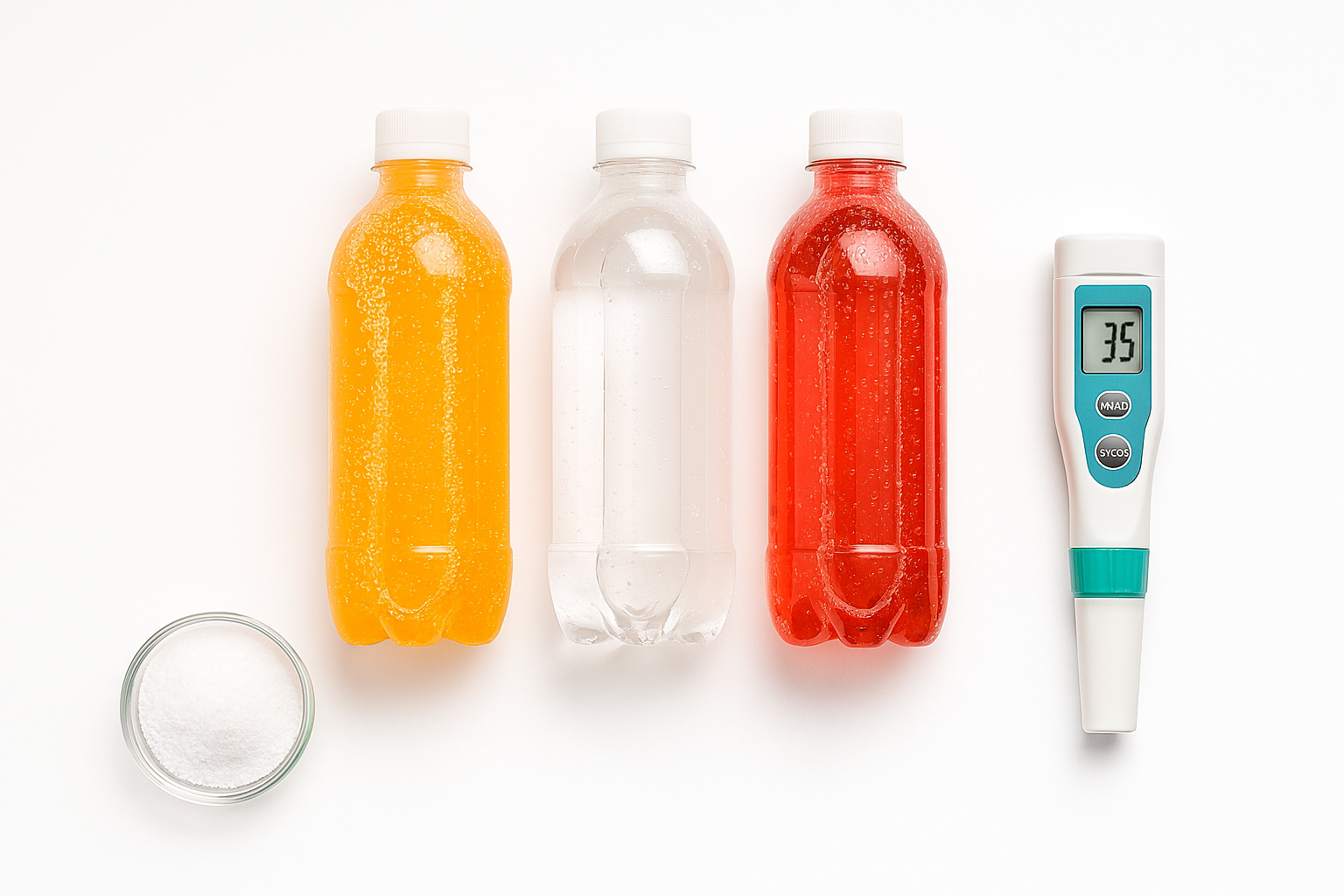
Combining preservatives and pH control is one of the key tools for ensuring the microbiological stability of soft drinks. Manufacturers are caught between consumer demands for a “cleaner” label and long shelf life, and the real‑world limitations related to hygiene, raw material quality and distribution conditions. Understanding how pH affects preservative efficacy, as well as how to leverage this synergy in formulation, is crucial for both technological and economic optimization of the product.
Microbiological risks in soft drinks
Soft drinks, especially sweetened and flavoured ones, provide a suitable environment for the growth of yeasts, moulds and certain acid‑tolerant bacteria. A high sugar content limits the growth of some microorganisms, but is by no means sufficient on its own to prevent spoilage, particularly in products with reduced sugar content or sugar‑free variants. The presence of natural ingredients such as juices, herbal extracts or fruit pieces further increases the risk.
In such an environment, the primary role of preservatives and pH control is to inhibit the activity and growth of dominant spoilage microorganisms, primarily yeasts and moulds, but also to reduce the risk of spoilage linked to acid‑tolerant microflora.
Why pH is critical for preservative efficacy
Most preservatives used in soft drinks (benzoates, sorbates, etc.) are effective only within a specific pH range. Their mechanism of action is based on the presence of the undissociated (non‑ionised) acid form, which can penetrate the microbial cell wall. The lower the pH, the higher the proportion of this active, non‑ionised form, and therefore the stronger the antimicrobial effect.
In practice, this means that the same nominal dosage of a preservative will not have the same effect at pH 2.8 and pH 4.2. At a lower pH, the preservative level can be reduced while maintaining microbiological safety, whereas at higher pH the same concentrations may be practically insufficient. The technologist must understand this relationship and design the beverage formulation so that the target pH aligns with the planned type and dosage of preservative.
Role of organic acids and buffers in formulation
Organic acids (citric, phosphoric, malic, lactic and others) in soft drinks have multiple roles: they shape the flavour profile, influence the stability of flavours and colours, and determine the pH of the system. When selecting an acid, technologists must consider not only sensory aspects, but also the technological effect on pH, buffering capacity and interactions with other ingredients.
Systems with strong buffering capacity can make pH adjustment more difficult and require higher acid additions to reach the target value. At the same time, overly aggressive acidification may have a negative impact on taste and consumer acceptance. The optimal strategy is to find a balance: pH should be low enough to support preservative efficacy, yet high enough to keep the product palatable and compatible with packaging and equipment, for example by avoiding excessive corrosivity.
Selecting preservatives according to beverage type and pH
Once the pH range of the product is defined, the next step is the selection of a preservative or preservative combination. In acidic carbonated and still drinks with pH below 4, benzoates and sorbates are the usual choice, either alone or in combination. Benzoates show better performance against yeasts and moulds in very acidic environments, while sorbates provide good protection at somewhat higher pH values, with a favourable profile against certain microorganisms.
For beverages containing juice, herbal extracts or with an increased risk of introducing microflora from raw materials, preservatives are often used at higher levels within the legally permitted range, combined with tighter control of pH and line hygiene. In low‑calorie and diet drinks with reduced sugar content, microbiological risk may be higher, making the preservative an even more critical part of the protective barrier.
Synergy between pH control and preservatives
The concept of hurdle technology involves combining multiple barriers that together hinder microbial growth. In soft drinks, the two most important barriers are low pH and the presence of a chemical preservative. When properly combined, it becomes possible to reduce preservative levels while maintaining effective microbiological protection and at the same time responding to pressure from consumers and retailers to reduce additives.
In practice, this means that the technologist should design the pH to maximise the efficacy of the selected preservative, but also to optimise the type and concentration of preservative according to the microbiological profile of the product and intended shelf life. Testing on real contaminants and storage under conditions similar to the distribution chain are essential to confirm this synergy instead of relying solely on theoretical calculations.
Impact of processing and packaging on preservative needs
Thermal treatments such as in‑bottle pasteurisation or hot‑fill processes can significantly reduce the initial microbial load. In some cases, this enables reduced usage or even omission of preservatives, provided that the pH is sufficiently low and the packaging acts as a barrier to oxygen and microorganisms. For products filled using cold‑fill processes, without thermal treatment or with minimal juice blanching, these barriers are absent or weak, and the role of preservatives and pH control becomes crucial.
The type of packaging (PET, glass, cans, multilayer cartons) influences permeability to gases, light and heat, which can indirectly affect microbial growth and ingredient degradation. Beverages intended for larger pack sizes and repeated opening require a more robust preservation strategy than small, single‑serve packages.
Formulation, interactions and sensory aspects
Preservatives and acids do not act in isolation. Soft drink formulations also include sugars or sweeteners, flavours, colours and sometimes stabilisers and pulp. All of these components can influence the perception of acidity and any off‑notes related to preservatives.
Some preservatives at higher concentrations may cause bitter or chemical notes, while combinations of different acids can change the acidity profile, for example the sharp sourness of citric acid compared to the softer character of malic or lactic acid. The technologist’s task is to optimise the formulation so that the consumer does not “detect” the preservative, but only the expected taste of the drink, with stability maintained throughout the entire shelf life.
Regulatory framework and labelling
The use of preservatives in soft drinks is strictly regulated, with defined permitted types, maximum levels and labelling requirements. The pH value itself is not directly regulated through a fixed numerical limit, but has indirect legal relevance because it determines preservative efficacy and the validity of label claims related to shelf life and product safety.
The manufacturer must be able to demonstrate that the combination of pH and preservative used is sufficient to ensure microbiological stability for the declared shelf life. In practice, this requires validation through microbiological testing, storage under accelerated and real conditions, and detailed documentation that can be presented to authorities or customers.
Cost optimisation through smart pH and preservative management
Preservatives, analyses, occasional batch returns or complaints due to spoilage all carry direct and indirect costs. A well‑designed strategy that combines pH control, selection of an appropriate organic acid and the minimum required preservative levels can reduce overall costs while lowering the risk of unstable batches.
A lower pH often allows for a lower preservative dosage, but may require higher acid levels and potential adjustments in flavour. Every change in formulation needs to be evaluated not only from a safety standpoint, but also in terms of cost impact, sensory properties and consumer perception, including the possibility of “no preservatives” claims where technologically and legally feasible.
Conclusion
Strategies for combining preservatives and pH control in soft drinks are one of the key elements of microbiological safety, stability and production efficiency. Preservative efficacy depends directly on pH, while pH must be carefully adjusted using organic acids to balance safety, taste and market requirements.
A successful formulation is based on understanding microbiological risks, the synergy between different hurdles, the impact of processing and packaging, and the regulatory framework governing preservative use. When these components are aligned, the manufacturer can offer a beverage with a stable shelf life, pleasant taste and transparent labelling, with controlled costs and minimal regulatory risk.