
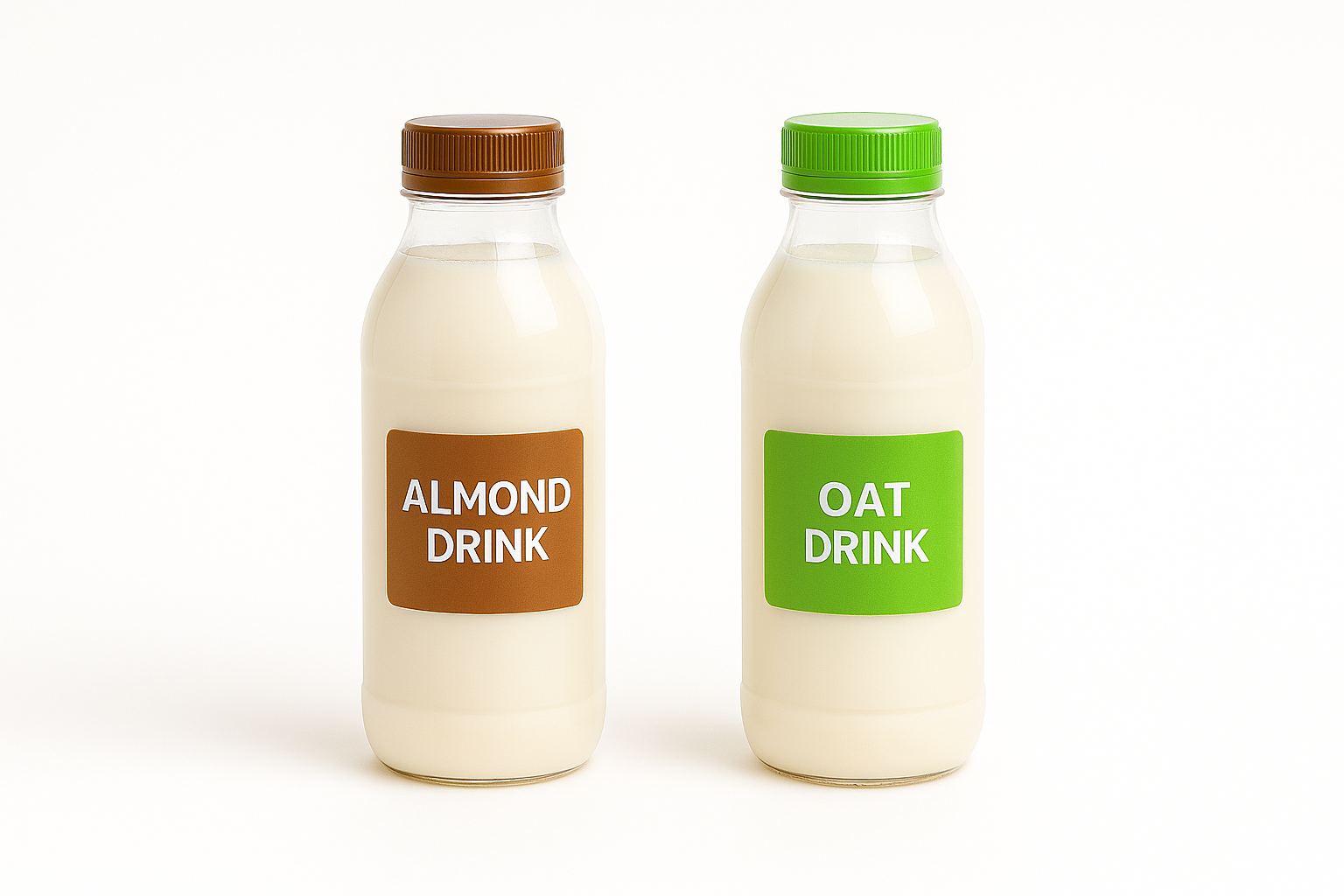
Why Plant-Based Milk Alternatives Are Inherently Unstable
In cow’s milk, evolution has “done the job”: the structure of casein micelles, the natural emulsion of milk fat and the presence of dissolved proteins and lactose create a system that is relatively stable under normal conditions. Plant-based alternatives have to imitate this, but they start from a completely different matrix.
In a typical plant drink there is, at the same time, an emulsion of vegetable fat in the aqueous phase, a suspension of fine particles (flour, fibers, protein aggregates) and a solution of soluble components. Each of these fractions tends to separate: fats tend to cream, particles sink or flocculate, and proteins can change solubility depending on pH, ionic strength and temperature. The result is layering, sediment and a visually unattractive, non‑uniform product if the system is not stabilized properly.
Additionally, increasingly common “high protein” plant drinks further complicate the situation. Pea, soy or grain‑combination proteins bring their own challenges: limited solubility at certain pH values, a tendency to aggregate during heat treatment and sensitivity to ionic strength. In such a matrix, hydrocolloids are not an aesthetic add‑on but a functional necessity.
The Role of Hydrocolloids in Protein Stability
Proteins in plant-based drinks function in an environment rich in polysaccharides, fats and particles of different sizes. In the case of soy or protein‑enriched green drinks (e.g. pea), the problem is often not only particle sedimentation but also changes in protein structure during processing. During UHT treatment or intensive pasteurization, denaturation and even aggregation of proteins occurs. If such aggregates do not have sufficient colloidal stability, they collide, merge and form visible flocs that sediment.
Hydrocolloids act on several levels here. By increasing the viscosity of the continuous phase, they slow sedimentation and reduce the frequency of particle collisions. By forming a weak three‑dimensional network, they can “trap” protein‑rich particles in a fine structure, preventing their separation and settling at the bottom. In some cases, controlled interactions between proteins and polysaccharides occur, resulting in more stable complex colloids. Such systems remain visually homogeneous even after prolonged storage, and any thin sediment that does form can be easily redispersed by gentle shaking.
It is crucial to understand that the same hydrocolloid will not give the same effect in soy and oat drinks, nor in low‑protein and high‑protein formulations. Function depends on pH, ionic strength, the presence of other polysaccharides and fats, as well as on process parameters.
Controlling Sedimentation: From Formulation to Process
Sedimentation in plant-based drinks can rarely be completely eliminated, but it can be brought into the zone of “technologically acceptable”. In practice, we distinguish between fine, thin sedimentation that does not bother the consumer and can be easily homogenized by shaking, and pronounced sedimentation with coarse particles that create a sandy mouthfeel and a visually off‑putting appearance in the package.
Sedimentation is influenced by particle size, the density difference relative to the phase in which they are dispersed, the viscosity of that phase and the degree of aggregation during processing. Hydrocolloids can adjust viscosity and reduce sedimentation rate, but they cannot compensate for extremely coarse grinding of the raw material or completely inadequate homogenization. Therefore, optimization must always be carried out simultaneously on formulation and process.
Homogenization affects the size of fat and solid particles and thus their tendency to sediment and cream. Too mild homogenization leaves large particles that sink faster, while overly aggressive homogenization can destabilize certain structures and even promote the development of off‑flavors due to oxidation or overheating. Similarly, the UHT or pasteurization regime must ensure microbiological safety without “overcooking” the protein fraction, as excessive denaturation would significantly increase the tendency to flocculate.
The hydrocolloid system is therefore always designed taking into account real process parameters: temperature, holding time, order of addition, available equipment for raw material milling and homogenization. Only when formulation and process “align” can sedimentation be kept under control.
Hydrocolloids and Mouthfeel: From Watery to Creamy
Mouthfeel is perhaps the most visible consequence of working with hydrocolloids. The consumer does not think about xanthan or locust bean gum, but very clearly distinguishes a watery drink without body from a fuller, “milky” feel or an overly thick, sticky product. The technologist’s task is to achieve the target texture for a specific product through careful selection and dosing of hydrocolloids.
Drinks that are consumed “like water” with meals or during the day require relatively low viscosity, but also the absence of a “plain water” feel. In such cases, a hydrocolloid is often used that provides a slight increase in viscosity and good particle suspension, without a pronounced “gummy” sensation. Oat or rice drinks that aim to replace classic milk, including “barista” versions for coffee, usually require more body, a creamy mouthfeel and the ability to foam. Here, combinations of hydrocolloids and possibly modified starches or soluble fibers come to the fore, together imitating a richer, fat‑containing profile.
On the other hand, excessive doses or inadequate hydrocolloid selection can lead to problems: porridge‑like or gelled textures, slippery, “slimy” feel, gummy resistance when swallowing or the impression that the drink sticks to the palate. Since different hydrocolloids give different rheological profiles (e.g. “short” or “long” texture), in practice blends at very low doses are often used, where each component contributes a small part and the overall effect is finely tuned and more natural.
Stability in Real Use Conditions
Stability of plant drinks does not end on the shelf. Consumers use them in various conditions: they mix them with hot coffee or tea, use them in cooking, make smoothies with acidic fruit or drink them straight from the fridge, sometimes after extended standing outside the cold chain. Each of these situations can “test” system stability.
Soy and pea drinks rich in protein are particularly sensitive to pH drop and higher temperature, so protein flocculation often occurs when adding them to coffee or tea. A hydrocolloid system that works well at room temperature and neutral pH may prove insufficient in a more acidic and warmer environment. Therefore, during development it is important to test products in real‑use scenarios, not only in static storage conditions.
“Barista” formulations are a good example of how the same type of drink can be given a different function. They are designed to be stable in hot coffee, not to “split” at elevated temperature and altered pH and to produce a stable, fine‑pored foam. At the core of this lies a carefully balanced ratio of proteins, fats and the hydrocolloid system, alongside strict process control.
Regulatory and Clean Label Aspects
In parallel with technological requirements, manufacturers face growing “clean label” pressure. Consumers increasingly read labels and pay attention to ingredients that seem “chemical” or unnatural. Certain hydrocolloids, although completely safe and regulatory‑accepted, may have a poorer public image, so some brands decide to avoid them.
This drives a shift towards texturizing solutions that are easier to communicate, such as fibers, starches or flours with functional properties, as well as towards hydrocolloids that do not have a strongly negative perception. The cost of this decision is often a narrower technological maneuvering space and greater dependence on process optimization. Instead of one very efficient hydrocolloid in a small dose, the formulation relies on combinations of ingredients with weaker individual effects, requiring more iterations and testing.
At the same time, allergen declaration and nutrition claims must not be overlooked. If the drink is positioned as a source of protein or as “high protein”, it is necessary to ensure a stable system in which the declared value is actually delivered throughout shelf life, without significant phase separation that would lead to non‑uniform distribution of proteins per unit volume.
Economics of Formulation and Supply Chain
Hydrocolloids, although used in small doses, have a significant impact on the cost structure of the recipe, especially at large production volumes. The difference between two stabilization systems is sometimes only a few cents per liter, but at annual production level this can represent a significant figure. On the other hand, savings on hydrocolloids can be more than offset by an increased number of complaints, product withdrawals or the need for shorter shelf life.
In addition, the plant-based segment is prone to rapid changes in consumer preferences and regulation, as well as changes in raw material availability. Technologists and procurement therefore have to collaborate already in the early development phase: hydrocolloid choice should consider not only functionality, but also supply reliability, price stability and potential future ESG requirements.
A flexible recipe design that allows one hydrocolloid system to be replaced by another with minimal changes in sensory properties and stability can be a strategic advantage. This implies clearly defined target rheological parameters, visual appearance and limits of acceptable sedimentation, as well as well‑documented correlations between composition and process.
Conclusion
Hydrocolloids in plant-based milk alternatives have a much broader role than simple “thickeners”. They are a key tool for controlling protein stability, reducing sedimentation and shaping mouthfeel that consumers will effortlessly accept as “normal” and pleasant. Successful formulation emerges at the intersection of three areas: understanding colloid chemistry and protein–polysaccharide interactions, a carefully selected and finely dosed hydrocolloid system and an optimized homogenization and heat‑treatment process.
Manufacturers who master this balancing act will be able to offer plant-based drinks that are simultaneously stable, tasty, texturally convincing and aligned with rising expectations around clean label and sustainability. In the competitive plant‑based segment, precisely this level of technological refinement often makes the difference between a product that briefly flashes and one that becomes a long‑term, recognizable consumer choice.