
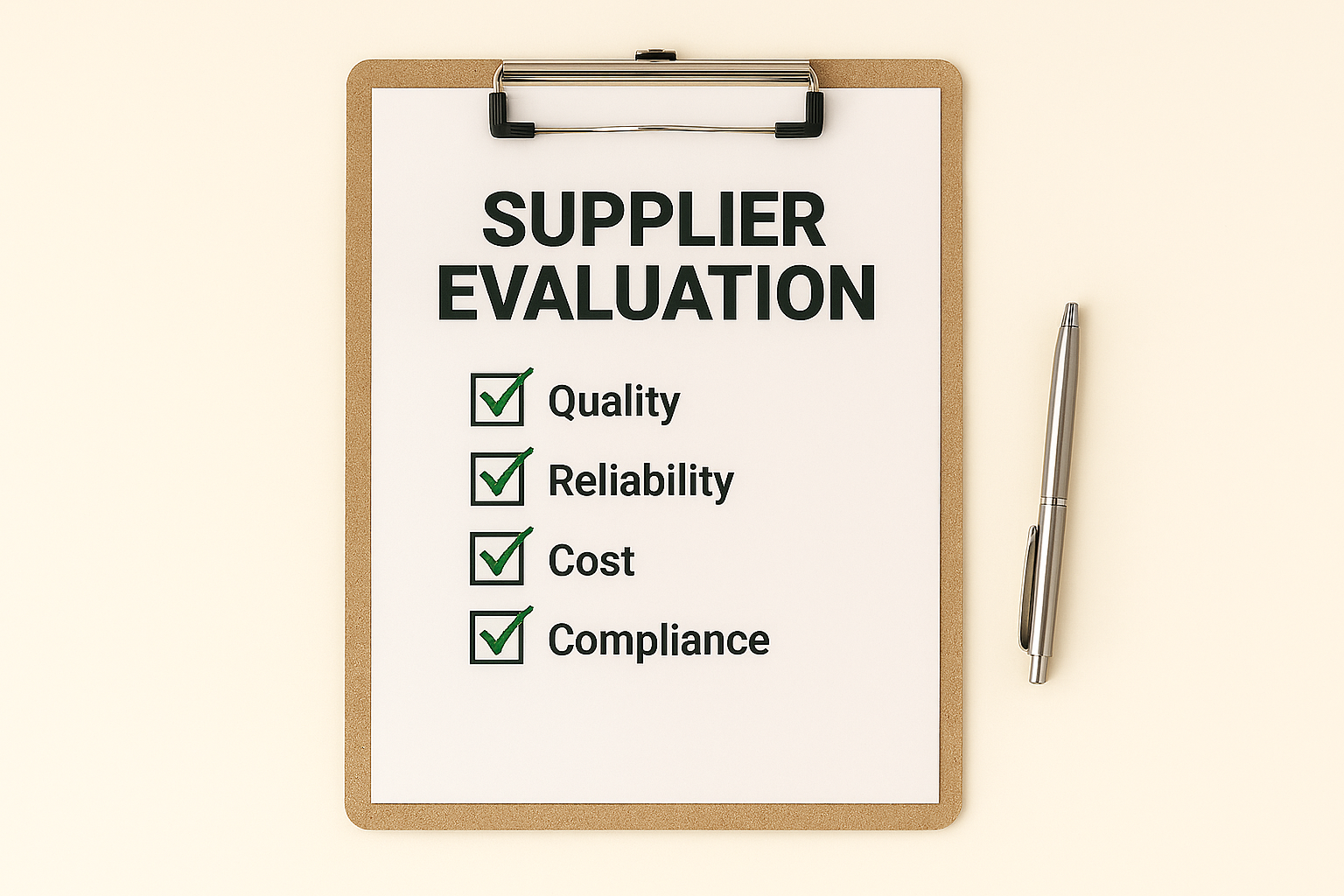
In the food industry, a raw material supplier is never “just another vendor.” Your supplier determines whether the line will run or stand still, whether your product will remain stable throughout its shelf life, whether you will face complaints, and what kind of reputation you will build with your customers. That’s why the question “how to choose a supplier” is really the question “who do we want as a partner for the next 5–10 years.”
If the decision is based only on price, you’ve already lost. Price does matter, but in a long-term collaboration it becomes just one of several factors – often not the decisive one. Far more important is how the supplier behaves when something goes wrong, whether they can deliver when the market goes crazy, how well they understand your technology, and how willing they are to grow alongside you.
Raw material quality: more than a single good analysis
Most suppliers send an “ideal” batch for initial testing – everything matches the specification, sensory quality is excellent, chemical and microbiological parameters are spotless. The real picture appears only after several months of cooperation, when various batches arrive, sometimes from different production runs or even different plants.
In the long run, you are not looking for a perfect batch – you are looking for consistent quality. Ideally, your technologist shouldn’t have to adjust the recipe or process every time because, for example, the flour has changed water absorption, cocoa has changed color intensity, milk powder has different solubility or foam stability, a protein behaves differently in foaming or viscosity, or an emulsifier behaves unpredictably in an emulsion. If your production is constantly “correcting” raw material deviations, you are actually paying the hidden cost of a poor supplier: through additional work, higher waste, non-value-adding activities, and potential complaints.
An important part of the evaluation is how the raw material ages. If the declared shelf life is 12 months but after six months the texture, color or solubility clearly deteriorate, you have a problem. A supplier who seriously cares about quality will not only provide a good initial specification, but also a realistic picture of how their product behaves throughout its entire shelf life – and the willingness to discuss that openly.
Certificates and food safety: the foundation of trust
Food safety should not become a topic only when an incident occurs. A stable partner in your supply chain is one with a robust system in place: HACCP as a minimum, and often ISO 22000, FSSC 22000, BRC or IFS, depending on market requirements. But a certificate by itself is not a guarantee; how the system is lived in practice matters much more.
Good suppliers provide documentation quickly, communicate the status of their certifications clearly, and don’t get annoyed when you ask for questionnaires, extra statements on allergens, GMO status, pesticides, or packaging migration. For them, this is everyday work. If you receive incomplete answers, delayed emails, or see them avoiding details – that is a signal that behind the scenes there is probably a lack of structure as well.
In food sectors such as dairy, meat, baby food or beverages, the risk of inadequately controlled raw materials can be extremely costly. A supplier who understands regulations and works on preventing problems is more valuable than one who always offers “the best price.”
Reliability of deliveries: when logistics becomes critical
Almost every manufacturer has a story about a “great supplier” who failed at some point – a delayed truck, no stock on hand, a blocked terminal, customs holding the shipment. An occasional incident can happen to anyone, but the way a supplier reacts is what separates a partner from a random vendor.
When evaluating a supplier, look at the pattern, not the single event. How often are they late? Do they notify you in advance if there will be a delay and offer alternatives (partial delivery, different packaging, supply from another plant)? What happens to quality when “it has to be fast” – do they sacrifice standards to meet the deadline, or are their internal controls strong enough not to allow that?
Logistics is not just the delivery date. It’s also the condition of the goods when they arrive: neatly stacked pallets, undamaged bags or sacks, correct labeling, and adherence to the cold chain where required. If your incoming inspection team is “saving the day” every time, you will eventually pay a high price for that relationship.
Technical support: who really helps you develop products
The more complex the ingredient, the more important technical support becomes. Additives, emulsifiers, hydrocolloids, enzymes, proteins, functional blends – all of these are components where the specification and price do not tell the whole story. Here, the know-how is crucial.
A supplier with a technologist or application specialist at your disposal, who understands the differences between bakery, confectionery, dairy, meat, and savory applications and can adapt recommendations to your process, is far more valuable than someone who only forwards a PDF technical data sheet. It’s especially valuable when they get involved in problem-solving: unstable emulsions in sauces, phase separation in confectionery fillings, dough drying too quickly or cracking, viscosity of beverages being too high or too low.
Such a supplier becomes an extension of your R&D department. In many plants, these kinds of partners are behind successful reformulations – reducing cost per kilo of finished product, moving towards clean label, adapting to new regulations, or even completely new products that open different markets.
Price and terms: what “competitive” really means
Price is the most visible parameter, but also the most dangerous one if seen in isolation. A material that is cheaper today but jumps 20–30% tomorrow because the supplier has no clear pricing policy can easily end up more expensive than the “slightly pricier” but stable option.
When evaluating a supplier, think in terms of total cost, not just unit price. If with a more expensive raw material you get better consistency, less waste, more stable production and a stronger label claim, it often turns out that the “more expensive” is in fact cheaper. Payment terms, volume bonuses, stability of pricing and transparency all come into play – do they clearly explain why a price adjustment is taking place (raw materials, energy, logistics, currency), or do they simply send a new price list without context?
A long-term partner will want you to remain competitive, because that’s how they secure their own stability.
Flexibility and innovation: the supplier as an ally in change
The food market is changing faster than ever: clean label demands, reduced sugar and salt, shift to plant-based alternatives, new ESG criteria, retail chain requirements, EU regulations pressure. The question is – does your supplier just passively observe all this, or actively track and adapt?
Suppliers who can develop tailor-made blends for your process, adjust granulation, packaging or concentration, or suggest alternatives when a specific ingredient becomes problematic due to regulation or reputation (certain colorants, preservatives, types of fats) are extremely valuable.
An innovative supplier is often a source of information on trends you may not yet see from your own production floor. They attend ingredient trade shows, work with many industries, and follow new functional ingredients closely. If you have open communication with them, you’ll be among the first to get ideas for new products – not the last.
Reputation, stability and ESG: who you are tying your name to
When you think about long-term cooperation, it’s worth asking yourself a simple question: do I want my name and brand associated with this company? This becomes especially important for raw materials under public scrutiny – cocoa, palm oil, coffee, sugar, soy, meat, dairy.
A supplier who takes ESG (environment, social, governance) seriously will have clear policies on deforestation, labor conditions, waste management, CO₂ footprint reduction and raw material traceability. Today this may look like “extra paperwork”, but very quickly it becomes a mandatory ticket into the supply chains of major retailers and international brands.
Reputation is checked both formally and informally. Look at how long they’ve been in business, who they work with, whether they are present at industry events, and if they publish technical articles or case studies. Conversations with peers in the industry often give you a more realistic picture than any official brochure.
Communication as a mirror of future cooperation
The way a supplier communicates during negotiations is often a preview of how collaboration will look later. If they are already slow to respond, fail to send requested documentation on time, avoid direct answers or “slack off” on details, it is unlikely this will magically improve after you sign a contract.
On the other hand, a supplier who openly talks about their limitations, discreetly warns you about potential disruptions in the supply chain, and proactively informs you about changes in formulation or packaging will likely behave just as transparently when there’s a real incident. In the food industry, you will never have a relationship without problems – the only question is with whom you will solve them faster, more simply and with less stress.
Bringing it all together into a decision
Ultimately, supplier evaluation should not be just a subjective impression from one department. Ideally, technology, procurement, quality, logistics, and sometimes finance and sales should all be involved. Each sees a different side of the picture: the technologist looks at functionality and consistency, quality at certificates and safety, logistics at delivery reliability, procurement at terms and price, management at long-term strategy and reputation.
It is worth creating an internal matrix, even a simple one, that covers these aspects and is updated regularly. Not to “punish” suppliers, but to give you a clear view of who truly contributes to your stability and growth, and who periodically causes more trouble than benefit.
When you look at things this way, a raw material supplier stops being “a cost to push down as much as possible” and becomes a strategic partner. And in an industry where a single bad batch can cost as much as your entire annual saving on price, that shift in perspective is what separates short-term arithmetic from long-term sustainable business.