
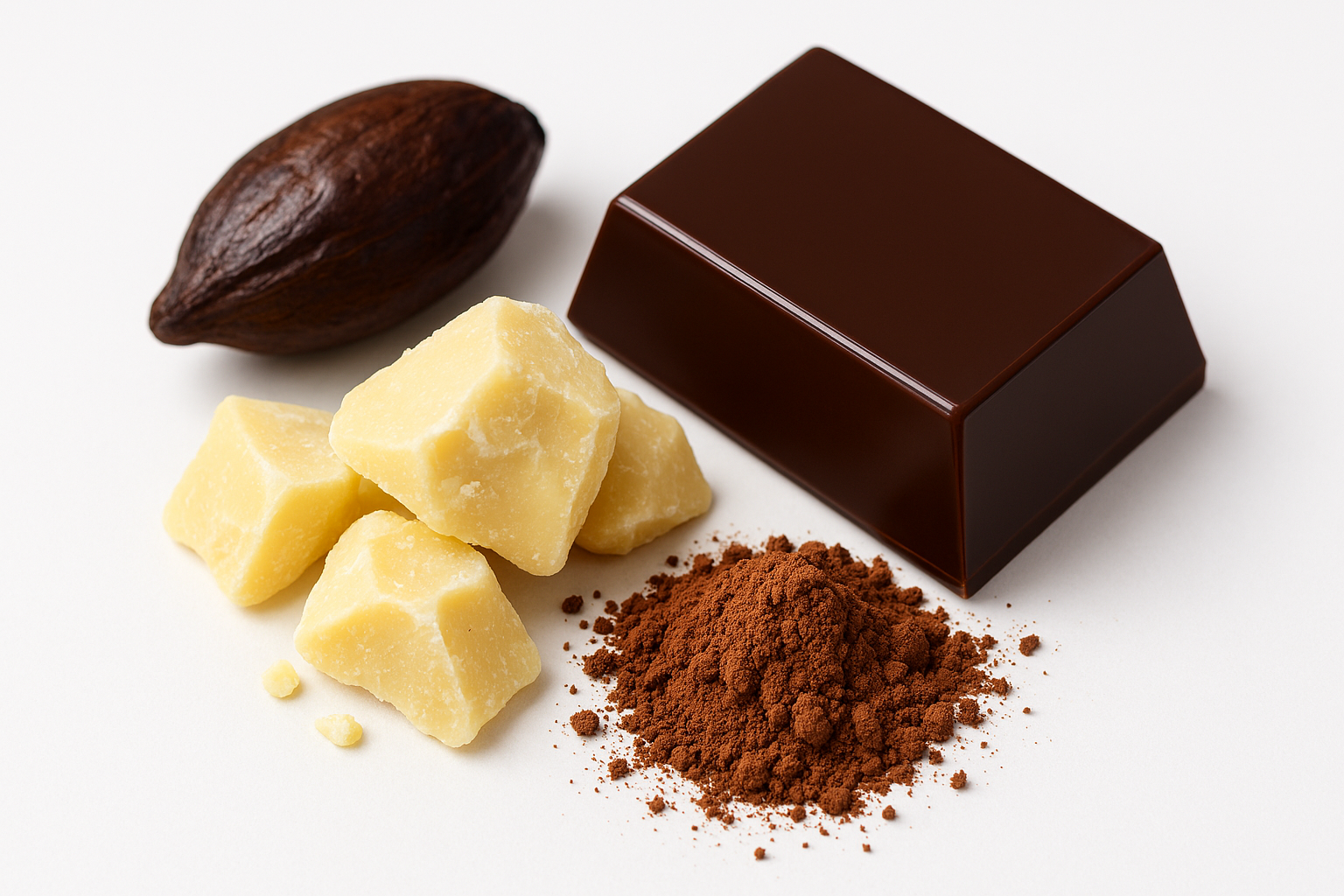
Once you step into the world of industrial chocolate, it quickly becomes clear that “chocolate” is not just cocoa mass, sugar and cocoa butter. Behind every tablet, coating or filling there is a chain of technical and commercial decisions, and one of the most important is which fat you decide to use.
For technologists, procurement and commercial teams, the question “cocoa butter or vegetable alternatives” is never just about price. Every choice affects texture, gloss, snap, temperature stability, labeling and market positioning. That’s why it is essential to understand the difference between cocoa butter, CBE, CBS and CBR before changing a recipe or sitting down with suppliers.
What exactly are cocoa butter, CBE, CBS and CBR?
Cocoa butter is the natural fat from cocoa beans and the core fat in real chocolate. It is responsible for the characteristic chocolate “snap” when you break a bar, the glossy surface and the pleasant melt-in-the-mouth feel without a waxy coating. Its specific triglyceride profile makes it hard to replace, but also expensive and exposed to volatility on the cocoa market.
CBE, or cocoa butter equivalent, are vegetable fats designed to behave very similarly to cocoa butter in processing. They typically come from palm, shea, sal, mango and similar oils. The key difference compared to other alternatives is that CBE can be blended with cocoa butter without dramatic changes in the fat crystal structure. Because of this, in the EU they can be used within defined limits while still keeping the product in the “chocolate” category. In practice, that means: if you want to optimize the recipe and still remain in “real chocolate”, CBE is the first category to explore.
CBS, cocoa butter substitute, is a completely different story. These are usually lauric fats, often based on coconut oil or palm kernel. They do not “speak the same language” as cocoa butter – they are not compatible in blends and require a different approach to formulation. On the plus side, CBS is easier to process: in many types of coatings and compounds, you can skip classic tempering, which significantly simplifies and speeds up production. The downside is a different sensory profile compared to real chocolate – structure can be harder, with a pronounced cooling effect and often a more waxy mouthfeel.
CBR, cocoa butter replacer, sits somewhere in between. These are non‑lauric fats that are partly compatible with cocoa butter, but not to the same extent as CBE. CBR is often used in compounds and products where you do not need to keep the legal definition of chocolate, but you still want something that feels closer to chocolate than a typical lauric glaze. In practice, CBR solutions are chosen when manufacturers want less demanding crystallization, more comfort on the line and better resistance to temperature fluctuations, without completely giving up a “chocolate-like” experience.
How these fats behave in chocolate processing
Technologically, the differences show up in several places. Melting point and melt profile directly influence mouthfeel. Cocoa butter and well‑designed CBE melt close to body temperature and provide the classic “chocolate melts in your mouth” sensation. CBS often has a higher melting point, so the product is firmer and more heat-resistant, but can feel cooler and more waxy on the tongue. CBR typically lands in the middle – more stable than pure cocoa butter, but sensorially different.
Another major aspect is crystallization and tempering. Cocoa butter is known for its polymorphism – to get a stable, glossy chocolate with good snap, you need precise tempering. The same is true for CBE, which behaves very similarly here. With CBS, tempering is often not required or is significantly simpler, which makes life easier when producing coatings for biscuits, wafers or ice cream. CBR can also reduce process sensitivity to small tempering mistakes, which is very useful on certain industrial lines.
Typical applications: where each fat makes the most sense
On the market, these technical differences translate into very specific applications. Cocoa butter is the first choice for premium tablets, pralines and brands that build their story around “real chocolate”, clean labels and superior sensory experience. In these categories, the consumer is buying indulgence and is willing to pay for it.
CBE is most often used in standard chocolate bars and products where manufacturers are balancing cost and quality. Industrial producers making large volumes of tablets, cooking chocolate or private label lines use CBE to reduce the share of expensive cocoa butter while still keeping an acceptable quality level and the legal “chocolate” status.
CBS is the workhorse of the glazing world. Coatings for biscuits, wafers, cereals and bars, as well as chocolate shells for ice cream, are often based on CBS. The reason is simple: you get a product that is stable, does not require sophisticated tempering, tolerates temperature shocks well (for example, freezing and thawing) and can be very competitive in cost. Consumers rarely expect these products to behave like premium chocolate, but they still expect a chocolate-like look and taste.
CBR is a frequent choice in the “middle” zone: various coatings and fillings, products for warmer climates, applications where you want a softer bite than a typical lauric glaze, but without all the constraints that come with real chocolate.
Regulation and labeling: chocolate or chocolate-flavoured coating?
Beyond technology, regulation and labeling are critical. In the EU and many other markets, there is a clear difference between “chocolate” and “chocolate-flavoured coating” or “compound”. To legitimately call a product “chocolate”, cocoa butter has to remain the core fat, with only limited amounts of CBE allowed. Once CBS or CBR take over most of the fat phase, you move into a different legal category – and the product needs a different name and declaration.
This has a direct impact on brand strategy. If the consumer expects to see “chocolate” on the front of pack, but the ingredient list and fat system are really closer to a glaze, you risk both regulatory issues and damage to reputation. That’s why procurement, R&D, QA and marketing need to work in sync: they must know which category you are targeting, what the legal limits are, and how fat changes will affect both the label and your consumer promise.
Price, margin and overall recipe economics
The economic side of the story is never just the price per kilo of fat. Cocoa butter is the most expensive and is exposed to a very volatile cocoa market. CBE is generally cheaper and allows recipe optimization while staying in the chocolate category. CBS and CBR often offer the lowest price per kilo of fat, but the key metric should be the cost per kilo of finished product – and the overall impact on waste, complaints and product stability in the distribution chain.
A cheaper fat does not automatically mean a cheaper product if it leads to more line waste, more returns or lower consumer acceptance. That is why it is crucial to calculate not only raw material price, but also its effect on processing, storage and shelf life.
The most common mistakes when switching to alternative fats
In practice, two big mistakes appear again and again. The first is direct replacement: “let’s just swap one fat for another and keep everything else the same.” That almost never works without side effects. Texture changes, snap and gloss are lost, fat bloom appears, or the coating behaves unpredictably on the line.
The second mistake is focusing only on price per kilo. If the decision is based purely on that one number, it is easy to overlook the real cost hidden in rejected batches, quality claims, weaker sensory performance and lower brand loyalty.
How to test and introduce new fats in a smarter way
A smarter approach starts with a clear objective. You need to define what you are trying to achieve: lower cost per piece, better heat stability, label adaptation for a new market, or a less fragile process on the line?
Then you narrow down a few realistic fat options with clear specs – for example, one CBE, one CBS and one CBR, depending on your product type. Next come pilot runs, first on a smaller scale and then at semi-industrial level, where you track snap, gloss, texture, sensory profile and storage behaviour.
It is equally important to simulate real-life conditions: warehouse temperature fluctuations, long-distance transport, and, where relevant, freezing and thawing for ice cream or chilled products. Only once you have a picture of how the new fat behaves in the actual supply chain can you make a responsible decision. At that stage, cross-functional collaboration is crucial – technology, QA, procurement and sales all see the product from different angles.
Where a good sourcing partner really adds value
In all of this, the role of a good sourcing partner is not just to quote a price list, but to look at the full effect of a change. A supplier who understands the difference between cocoa butter, CBE, CBS and CBR – and how each behaves in different product types – can help you narrow down the options to a few realistic, well-matched candidates from the start.
If you are considering recipe optimization for chocolate tablets, coatings, fillings or decorations and are not sure how to balance cost, quality, labeling and processing demands, it pays to have an expert discussion before the first trial batch. The right fat combination can mean a more stable product, better line efficiency and far fewer surprises in peak season.