
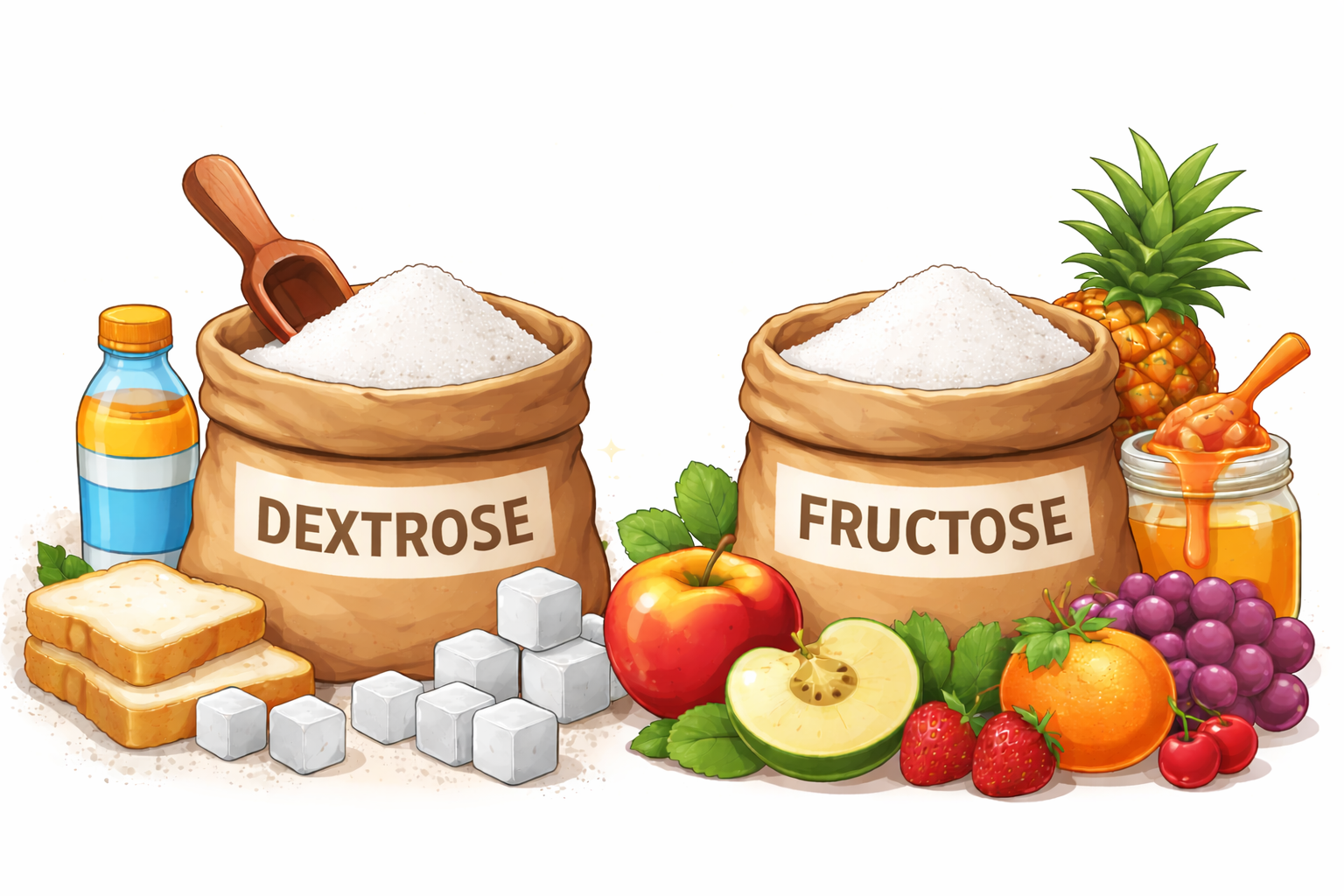
In industrial food production, “sugar” is never just sugar. Behind that word stand different raw materials with completely different behavior in process and in the finished product. Two of the most common are dextrose and fructose – on paper both simple sugars, in practice two tools with very different effects.
If you work in recipe development, cost optimization or supplier changes, you quickly run into the question: is dextrose or fructose better for this product? And is the real point choosing one, or designing a smart combination?
Below, we’ll go through the differences in a way that’s useful both for technologists and purchasing – looking at taste, texture, fermentation, labeling and cost.
What are dextrose and fructose, really?
Dextrose is the industrial name for D-glucose, most commonly obtained from corn starch. In practice you see it as dextrose monohydrate – a white crystalline powder, neutral in taste and mildly sweet. Compared to sucrose, dextrose has around 70–75% of its sweetness. Because of its structure, it is more than just a sweetener: it affects color, fermentation, texture and therefore also freshness and shelf life.
Fructose is fruit sugar – a monosaccharide naturally present in fruit and honey, used industrially mainly as crystalline fructose or in high-fructose syrups. It is noticeably sweeter than sucrose – depending on conditions and matrix, its sweetness ranges from around 120 up to 180% compared to table sugar. It is especially “powerful” at lower temperatures, which matters for beverages and frozen desserts.
Already from this basic difference in sweetness we see a practical effect: to reach the same perceived sweetness level, you need less fructose and more dextrose. But that’s only the beginning of the story.
How do they differ in taste and perceived sweetness?
Dextrose provides a clean but mild sweetness. It’s not dominant, it doesn’t “shout” in the product, but rather discreetly lifts the overall taste. That’s why it fits well where sugar is not the star of the recipe, but a support player – in bread, bakery items, meat products, sauces.
Fructose, on the other hand, brings a more intense, “sharper” and often fruitier sweetness profile. It comes into its own particularly in cold drinks, toppings and fruit preparations. If you have a syrup or beverage that needs to “hit” the desired sweetness on the very first sip, fructose will do that with a lower dosage per liter.
In practice this means, for example, that in a soft drink fructose will very easily take on the role of main sweetener, while in a bakery product dextrose will quietly handle several tasks at once – from fermentation to light caramelization.
Impact on texture, color and process behavior
What often decides whether the technologist is satisfied with a formulation is not just sweetness numbers, but texture and stability.
Dextrose is an excellent “player” in Maillard reactions – the same reactions that give golden-brown color to bread, rolls, crusts but also to meat products. It helps with controlled browning and gives character to the product. In addition, it acts as a humectant: it helps retain moisture and influences softness and freshness, particularly in bakery items. In ice creams and frozen desserts it also impacts the freezing point – helping the product not to become rock-hard, but scoopable.
Fructose is also a strong humectant, but its effect is perhaps most evident in fruit toppings, fillings and jams. It provides juiciness, shine and a sense of “full” flavor. In confectionery it can contribute to a pleasant softness, but at high dosages it can also lead to unwanted stickiness, which then becomes a matter of fine-tuning the formulation.
If you have a product where you want a clear, controlled “stamp” in terms of color and structure (bakery, meats, snacks), dextrose will usually be the logical choice. If the focus is on fruit, shine, juiciness and strong sweetness – fructose very often makes the difference.
Fermentation: why yeast loves dextrose
In bakery, bakery mixes and fermented products, the sugar you use has a direct impact on yeast performance. Dextrose is one of yeast’s favorite sugars – it is quickly metabolized and reliably initiates fermentation. That means predictable dough rising, stable volume and consistent results from batch to batch.
Fructose is fermentable as well, but in most standard bread and bakery formulations, glucose/dextrose has a clear advantage. If fermentation is a key part of your process, dextrose is, in practice, the safer choice – especially when you want to combine technological security with additional effects on color and texture.
How do they behave in beverages and cold applications?
Once we move to liquid products, priorities shift. In drinks, the focus is on refreshment, sweetness and stability, often at low temperatures.
Dextrose dissolves very well and has its place in sports and isotonic drinks, where in addition to taste, the goal is a quick source of glucose for energy. But if we’re talking about “regular” soft drinks, syrups for dilution or fruit beverages, dextrose alone often won’t be the first choice as the main sweetener, precisely because of its lower perceived sweetness.
Fructose is much “louder” here. At low temperatures it delivers a strong sweetness perception, which is why it is particularly suitable for carbonated and still drinks, iced teas, syrups as well as for ice creams and frozen desserts. A smaller amount of fructose can achieve that “first wave” of sweetness a consumer expects from a sip or bite.
Labelling, perception and trends
On the label, both dextrose and fructose are sugars, but they differ in communication and perception.
Dextrose (glucose) is often used in the context of medical and sports nutrition, where it is highlighted as a quick source of energy. It can fit into the narrative of products targeting athletes, active consumers or people with specific nutritional needs.
Fructose, as “fruit” sugar, used to enjoy a more positive image in the eyes of consumers, primarily due to its association with fruit and natural sources. Today the picture is more complex and depends on the market, regulation and brand communication. In some categories it can still help position a product as fruit-based or give it a specific sweetness profile, but it requires careful alignment with current legislation and nutrition guidelines.
For manufacturers this means that the technological decision must be aligned with the marketing strategy and legal framework. It is not the same whether you want to communicate your product as “sports”, “fruit-based”, “with reduced sugar content” or something else entirely.
Cost: why looking only at price per kilogram is not enough
From a purchasing perspective, the first figure everyone looks at is price per kilogram. But with dextrose and fructose, that’s only the start of the calculation.
Fructose is usually more expensive per kilogram than dextrose, but because of its higher sweetness you need less of it to achieve the same perceived sweetness level. If you only look at the price per kg, fructose seems like an “expensive option”. If you look at price per sweetness unit, the picture changes.
On the other hand, dextrose often does several jobs at once: it feeds yeast, contributes to color, impacts texture and freshness. In such cases, its contribution to the technological process reduces the need for other additives or corrections, which indirectly shows up in the total formulation cost.
The third layer is logistics: regional availability, reliability of supply, the ability to work with stock and flexible delivery times. A stable supply chain can sometimes be worth more than a small difference in price per kilogram.
The best approach is for technology and purchasing to evaluate cost per function: what is the real cost of sweetness + texture + stability + logistics under your actual production conditions.
How to make a practical decision for your product
If we bring all this down to day-to-day work, it’s helpful to ask yourself a few clear questions:
- In what type of product are we using sugar – a drink, bakery item, meat product, fruit topping, ice cream, supplement?
- Is sugar primarily a sweetener for us, or does it also have a key technological role (fermentation, color, freezing point, structure)?
- How is the product consumed – cold, hot, baked, frozen?
- What matters on the label and in communication with customers – fast energy, fruit character, lower sugar content?
- How sensitive are we to fluctuations in raw-material prices and availability?
In bakery and meat products, and in most applications where fermentation, color and texture are crucial, dextrose will very often be the first option. In soft drinks, syrups, fruit fillings and toppings, fructose will often give a better balance between intensity of sweetness and total sugar dosage.
Very often, the best result does not come from a rigid “either–or” choice, but from combining several types of sugars and syrups, where each of them covers its own part of the job: one for sweetness, another for texture, a third for color or fermentation.