
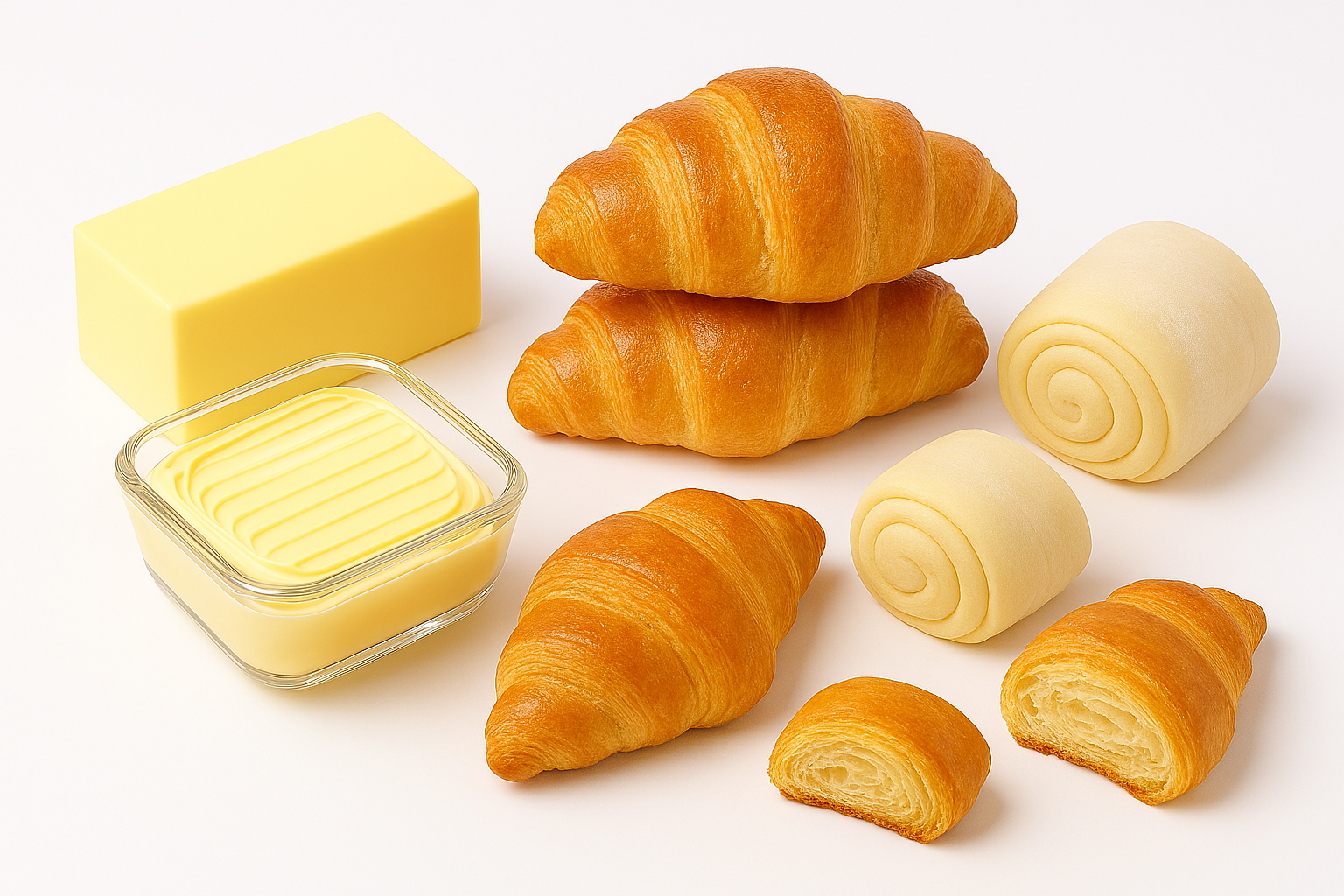
In puff pastry and croissants, margarine is the key structuring fat. If the margarine is chosen poorly, no recipe or machine will save the product. The layers will not lift properly, fat may leak out during baking, and the croissant can end up low, dense or chewy.
Because of this, modern bakeries do not work with one universal margarine. Instead, they use a family of specialized laminating margarines, tailored to different products and processes, from small artisan bakeries to industrial lines producing frozen semi finished goods.
Where Specialized Puff Pastry Margarines Are Used
Laminating margarines appear in several typical product groups.
Classic puff pastry for small pies, sticks, burek style savoury products and sweet snacks usually relies on a standard pastry margarine. Croissants and other viennoiserie such as pain au chocolat demand a different profile with more elasticity and a finer layer structure.
Snack and finger food items, such as filled puff pastry pieces, rolls and tart bases, often sit somewhere between these two worlds. They must combine clean lift with good fat stability and easy handling.
There is also a rapidly growing frozen segment. Frozen puff pastry sheets and frozen croissants are baked in supermarkets, petrol stations and in the HoReCa sector. These products require margarines that can survive freezing, transport and baking at the point of sale.
Each of these groups has its own technological demands, which is why one single margarine rarely works well for all applications.
The Main Roles of Margarine in Puff Pastry
To understand why there are so many types of margarine, it helps to look at what margarine actually does in laminated dough.
First, margarine separates the layers of dough during lamination. It is incorporated as a slab, then folded repeatedly. During baking, the water in the dough turns to steam, the layers rise and the characteristic flaky structure appears.
Second, margarine controls volume and lift. Its hardness and melting point determine whether the layers will open evenly or stick together and remain low. If it is too soft, it may smear into the dough and the layer definition will disappear. If it is too hard, it can crack and break the lamination.
Third, margarine contributes strongly to flavour and mouthfeel. The fat profile and any added flavourings, such as dairy or butter notes, make the product feel rich and indulgent or, on the other hand, thin and empty.
Finally, margarine has to behave well during the process. It should withstand lamination, possible freezing and thawing, proofing in the case of croissants, and baking. Through all of this it should not crack, leak or separate from the dough. Different process conditions therefore call for different formulations.
Classic Puff Pastry Margarine
The basic industrial standard for puff pastry is classic pastry margarine. This is a firm block margarine designed specifically for lamination.
It typically has a high fat content, often eighty percent or more, with very little water so that the dough structure is not disturbed. It is supplied in blocks or slabs, for example two kilogram or five kilogram units, which makes it easy to place between dough layers. The formulation is tuned so that the margarine is plastic and workable at typical bakery temperatures, usually around 12–18 °C.
This type of margarine is ideal for standard puff pastry products, both savoury and sweet, and for bakeries that produce fresh items without freezing. It can also be used for simpler croissant recipes for local distribution. In many portfolios this is the workhorse margarine, offering a good balance between cost, performance and ease of use.
High Plasticity Margarines for Croissants
Croissants place higher demands on the fat phase than classic puff pastry. They require more elasticity, finer and more regular layers, and a specific open crumb structure in the cross section. For this reason, dedicated croissant margarines have been developed.
Compared with classic pastry margarines, croissant margarines offer a wider plasticity range. They are soft enough to accept multiple folds without cracking, but not so soft that they become sticky and unmanageable. Their composition is tuned to create fine, uniform layers and good volume after proofing and baking. Very often they also carry a mild dairy or butter flavour to support the sensory profile expected from a croissant.
These margarines are the preferred choice for premium croissants, for filled croissants with cheese, ham or chocolate, and for mini croissants for retail and the HoReCa sector. For a brand that takes croissants seriously, using a dedicated croissant margarine is almost essential. Standard pastry margarine tends to produce products that are too low or too dense.
Butter Blend Margarines
Between pure vegetable margarine and one hundred percent butter there is an important middle ground, butter blend margarines. These are blends of vegetable fats and butter fat designed to give a butter like flavour while retaining the technological benefits and cost advantages of margarine.
Butter blend margarines are used when a premium flavour is required but full butter is too expensive or too sensitive in processing. They allow producers to highlight butter on the label, improve the sensory profile of croissants and puff pastry, and still keep better plasticity, stability and price control than with pure butter.
They are especially attractive for higher tier croissants, puff pastry positioned as premium, and HoReCa products where a distinct buttery note is desired but food cost must remain under control.
Clean Label and Trans Fat Free Solutions
Regulatory pressure and consumer expectations are pushing the market towards trans fat free and non hydrogenated fats, as well as shorter and more familiar ingredient lists, the so called clean label trend. Puff pastry margarines have followed this direction.
Clean label and trans fat free margarines rely on specially fractionated vegetable fats, such as palm, shea, rapeseed or sunflower, to achieve the required melting behaviour without classic hydrogenation. Emulsifiers and additives are chosen carefully so that they are acceptable from a clean label standpoint while still providing the necessary structure and stability for lamination.
These products are particularly important for brands that target health conscious consumers in retail, for export markets with strict legislative limits on trans fats, and for private label projects that want a marketing advantage and a better declaration. They usually cost more than standard margarines, but they come with a stronger story at the shelf.
Margarines for Deep Freezing
Frozen croissants and puff pastry have become a core category in modern bakery, both for retail bake off concepts and for foodservice. Products may be shock frozen at very low temperatures, stored for months, transported over long distances and then baked directly from frozen or after proofing. For this, the margarine must be stable under freezing and thawing.
Such margarines are formulated to develop a favourable fat crystal structure that does not crack or change dramatically under freezing. Their structure remains stable, so the margarine does not separate from the dough and the layers do not stick together. Even after several months in the freezer, products made with these margarines should still achieve good lift and flakiness.
They are used wherever frozen semi finished products dominate the production concept, in industrial lines that fill freezers and ship throughout a region, and in supermarket bakeries and petrol stations. Using a non stable margarine in these concepts almost guarantees complaints and high waste.
Different Melting Points for Different Needs
Another important parameter when selecting a laminating margarine is its melting point. This influences how the fat behaves during baking and how it feels in the mouth.
Margarines with a lower melting point tend to give softer products and a pleasant, fast melt in the mouth, but they are more sensitive to higher temperatures during lamination and handling. Medium melting point products represent a compromise that is suitable for most puff pastries and croissants. High melting point margarines are used in warmer bakeries or for products that will stand for longer periods in ambient displays. In these cases, more resistance to softening is needed, but care must be taken to avoid a waxy sensation on the palate.
For this reason suppliers often offer several grades of croissant margarine with different melting points, for example thirty two, thirty six or forty degrees Celsius. The technologist chooses the option that best matches the process conditions and the sensory targets.
Artisan and Industrial Laminating Margarines
The same margarine is rarely optimal for both a small artisan bakery and a large industrial line. These environments differ in process control, equipment and temperature stability.
Artisan bakeries typically work in batches, often with manual or semi automatic lamination, and their workshop temperature can fluctuate significantly during the day and between seasons. Freezing may be limited or absent. In such cases, a more forgiving margarine with a wide plasticity range and good tolerance to temperature variations is desirable. The format is also important, blocks that are easy to handle manually save time and effort.
Industrial lines operate at high speeds with tightly controlled dough and ambient temperatures. Freezing is often an integral part of the process and shelf life expectations are higher. In these plants, the margarine needs very precisely defined properties, such as melting point, hardness and block dimensions, and is usually supplied in standardized blocks optimised for automatic laminators. Batch to batch consistency has to be high to prevent disruptions in production.
Many margarine manufacturers therefore offer separate artisan and industrial lines, and both technologists and procurement decide which variant suits their plant setup and product portfolio.
How to Specify Margarine for Puff Pastry
To receive a suitable proposal from a supplier, the technologist should define a few key points.
The first point is the product type. It should be clear whether the focus is on classic puff pastry, croissant, frozen croissant, snack products, tart bases or other items.
The second point is the process. The supplier needs to know whether lamination is manual or mechanised, how many folds are used, and whether the products are frozen and for how long.
The third point concerns production conditions. Typical workshop temperature, whether production runs during summer without air conditioning, and how proofing and baking are organised all influence the choice of fat phase.
The fourth point is the sensory target. It should be defined whether the product is standard or premium, whether a distinct buttery profile is required, how many visible layers are expected and how crisp the final texture should be.
Finally, marketing requirements should be clearly explained. These include clean label positioning, trans fat free formulation, palm versus palm free sourcing and the possible use of butter on the label. With this information, the supplier can usually propose two or three options, for example a standard pastry margarine, a croissant margarine and a butter blend or a frozen product variant. Test baking then shows which option performs best.
Conclusion
Margarines for puff pastry are not a single product but an entire platform of laminating fats. Classic pastry margarines cover standard puff pastry needs. Dedicated croissant margarines help achieve the expected volume and open crumb. Butter blend systems deliver a more buttery profile at a manageable cost. Clean label and trans fat free solutions respond to regulatory and consumer pressure. Freeze stable variants support frozen product concepts, and different melting points allow fine tuning for specific process conditions.
When the product concept, the process design and the choice of margarine are planned together, bakeries gain a stable puff pastry and croissant range, reduced waste and a recognisable quality signature for their brand.